News
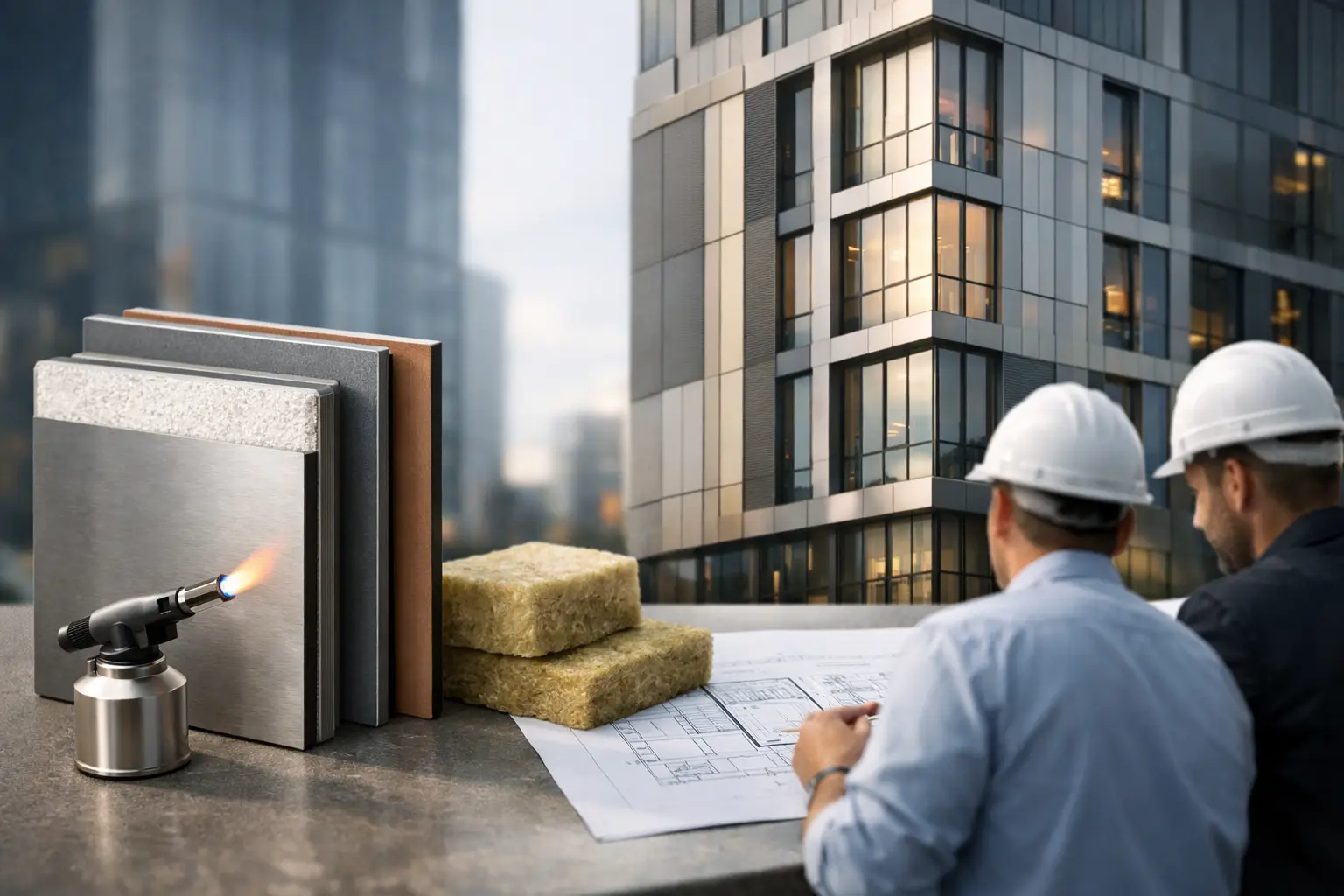
A facade panel can carry an A2 classification and still be the wrong answer for a project. The distinction matters because the building envelope is not approved as a collection of individual materials. It is evaluated as a wall assembly, with its insulation, air and water barrier, subframing, attachments, cavity conditions, and installation method all affecting fire behavior. This FR-A2 panel review examines what experienced specifiers should verify before allowing a panel classification to drive a major facade decision.
For high-rise, hospitality, airport, healthcare, and mixed-use work, FR-A2 panels occupy an important position: they can deliver the flatness, finish range, and fabrication advantages associated with metal composite materials while addressing elevated fire-performance requirements. The right evaluation is not a simple pass-fail comparison. It is a disciplined review of classification, assembly evidence, material consistency, detailing, design intent, and supply capability.
What an FR-A2 panel designation actually tells you
FR-A2 generally refers to a panel designed to achieve a high reaction-to-fire classification under applicable testing frameworks, most commonly EN 13501-1 in markets where the Euroclass system governs. In that framework, A2-s1,d0 is often the performance level designers seek for non-combustible or limited-combustibility facade applications. The designation may address parameters including heat release, smoke production, and flaming droplets.
That is valuable information, but it is not a universal statement that every FR-A2 panel is interchangeable, noncombustible under every code definition, or suitable for every wall configuration. Local code language, authority having jurisdiction requirements, project height, occupancy, and assembly type remain decisive. A panel’s test report should identify the precise product construction, thickness, coating, and classification achieved, rather than relying on a generic product-family claim.
For U.S. projects, an EN classification may support product evaluation, but it does not replace the evidence required by the adopted building code. Exterior walls on many multistory projects require testing or engineering analysis related to NFPA 285. Canadian projects may require CAN/ULC-S134 evidence. In other jurisdictions, BS 8414, EN 13501, or national facade regulations may apply. The correct question is not, “Does this panel have an A2 rating?” It is, “Does this documented panel work within a documented, code-appropriate wall assembly?”
FR-A2 panel review: start with the full wall assembly
The first document to request is not a color chart. It is the fire-performance package for the proposed facade system. Review the panel alongside the insulation type and thickness, membrane, cavity, attachment method, air space, perimeter detailing, and substrate specified for the project. Minor substitutions can matter. Changing insulation, adding a thermal break, revising the cavity dimension, or using an alternate rail system may move the installed wall away from the tested configuration.
NFPA 285 is especially significant in the United States because it evaluates fire propagation characteristics of exterior wall assemblies, not just a cladding face. A panel supplier should be able to clarify whether its product has been included in tested assemblies, which components are permitted, and where project-specific engineering review may be required. Broad phrases such as “NFPA 285 compliant” deserve closer examination unless they are supported by a complete, applicable assembly record.
This is also where facade consultants and contractors should distinguish testing from extrapolation. Both can have a role in project approval, but they are not the same. A tested assembly provides direct evidence for a defined construction. An engineering judgment may be appropriate where accepted by the authority having jurisdiction, yet it depends on the quality of the supporting test data and the similarity of the proposed wall to the tested design. Procurement teams should account for that distinction early, before a lower initial panel price produces delays during submittals.
Examine the core, skins, and production controls
An FR-A2 composite panel is a layered material. Its exterior aluminum skins, mineral-filled fire-retardant core, bonding system, protective coatings, and finish each contribute to final performance and appearance. The quality question is therefore larger than nominal panel thickness or a single fire-classification label.
Start with product construction. Confirm the nominal thicknesses of the aluminum skins and the total panel, then verify that the offered product matches the tested and approved product. Skin thickness influences panel stiffness, fabrication response, impact resistance, and perceived flatness. Core formulation influences fire behavior, weight, cutting characteristics, and long-term panel integrity. Bond strength is equally relevant because delamination can compromise both facade appearance and service performance.
Vertically integrated manufacturing brings a practical advantage in this review. A manufacturer that controls mineral-core inputs, adhesives, coated coils, and finishing operations has greater ability to maintain consistency from qualification samples through project deliveries. For a large facade package, this control can be as important as a published data sheet. Alubond’s integrated production model, spanning fire-retardant mineral cores, bonding materials, color-coated coils, and custom paints, reflects the level of process control sophisticated projects should seek.
Ask for current technical data, relevant test documentation, warranty terms, and identification of the actual production source for the project. A sample panel is useful for finish approval, but it cannot independently verify production consistency across thousands of square feet. The submittal process should connect the approved sample, specified panel construction, test evidence, and final purchase description.
Fire performance must coexist with facade performance
A highly rated panel is only valuable if it also delivers the architectural and operational performance the project requires. FR-A2 panels are specified because facade design cannot be reduced to fire testing alone. Color fidelity, gloss level, metallic effects, weather resistance, formability, panel flatness, and compatible fabrication methods all influence the completed building.
Finish selection deserves more than an aesthetic discussion. Dark colors can experience greater solar heat gain, which may increase thermal movement and make detailing more demanding. Highly reflective finishes can reveal waviness or inconsistency under changing daylight. Custom colors may require added lead time, color-control procedures, and clearly defined batch management. On expansive elevations, establish whether panels will be supplied from controlled production lots and how color variation will be evaluated in field conditions.
Fabricators should review routing, bending, cassette construction, edge returns, and attachment requirements against the selected panel’s technical guidance. Not every panel construction responds identically to fabrication. A specification that calls for sharp returns, complex geometry, or large unsupported spans should be coordinated with the panel supplier and fabricator before the finish is released for production. This is particularly relevant for airports, podiums, and corporate campuses where large, visually uninterrupted elevations make small alignment errors visible.
Compare suppliers beyond the test certificate
A credible FR-A2 panel review also evaluates the supplier’s ability to support the project after selection. For internationally sourced cladding, the risk is rarely limited to whether material can be quoted. The more meaningful questions concern traceability, technical response time, replacement-panel availability, documentation quality, and the ability to maintain specified finishes through phased construction.
Evaluate whether the supplier can provide project-specific color matching, fabrication guidance, and complete fire documentation in the format the design team and authority require. Confirm expected lead times for standard and custom finishes, minimum order quantities, packaging methods, and the process for handling damaged or rejected panels. For a project with multiple elevations or construction phases, clarify whether future production can match the approved finish or whether reserve stock should be included in the initial order.
Global manufacturing capacity can reduce supply risk when it is paired with disciplined quality control and clear project allocation. It does not eliminate the need for an early procurement plan. Custom coils, specialty metallic surfaces, and project-specific fire-rated constructions can have longer decision paths than standard finishes. The best time to resolve these variables is during design development, not when curtain wall and rainscreen sequencing are already committed.
A specification decision, not a marketing decision
FR-A2 panels can be an appropriate choice where demanding fire expectations, high-quality architectural finishes, and scalable fabrication must work together. They are not automatically the preferred material for every building. A lower-rise project, a jurisdiction with different code pathways, a facade requiring heavier-gauge solid aluminum, or an assembly with unique impact and abuse requirements may call for another solution.
The strongest specification sets clear performance requirements, identifies accepted assembly evidence, defines finish and fabrication expectations, and requires documentation tied to the exact proposed product. That approach gives architects freedom to design distinctive facades while giving owners and contractors a more defensible route through approvals, procurement, and installation. When the panel, wall assembly, and delivery plan are reviewed as one system, fire-rated cladding becomes a controlled building-envelope decision rather than a late-stage material gamble.
RECENT POSTS

October 6 , 2026

October 4 , 2026

October 2 , 2026

September 30 , 2026

September 28 , 2026

September 26 , 2026

September 24 , 2026

September 22 , 2026

September 20 , 2026

September 18 , 2026

September 16 , 2026

September 14 , 2026

September 12 , 2026

September 10 , 2026

September 8 , 2026

September 6 , 2026

September 4 , 2026

September 2 , 2026

August 31 , 2026

August 29 , 2026

August 27 , 2026

August 25 , 2026

August 23 , 2026

August 21 , 2026

August 19 , 2026

August 17 , 2026

August 15 , 2026

August 13 , 2026

August 12 , 2026

August 12 , 2026

August 12 , 2026

August 12 , 2026

August 12 , 2026

August 12 , 2026

August 12 , 2026

August 12 , 2026

November 2 , 2022

April 26 , 2022

