News
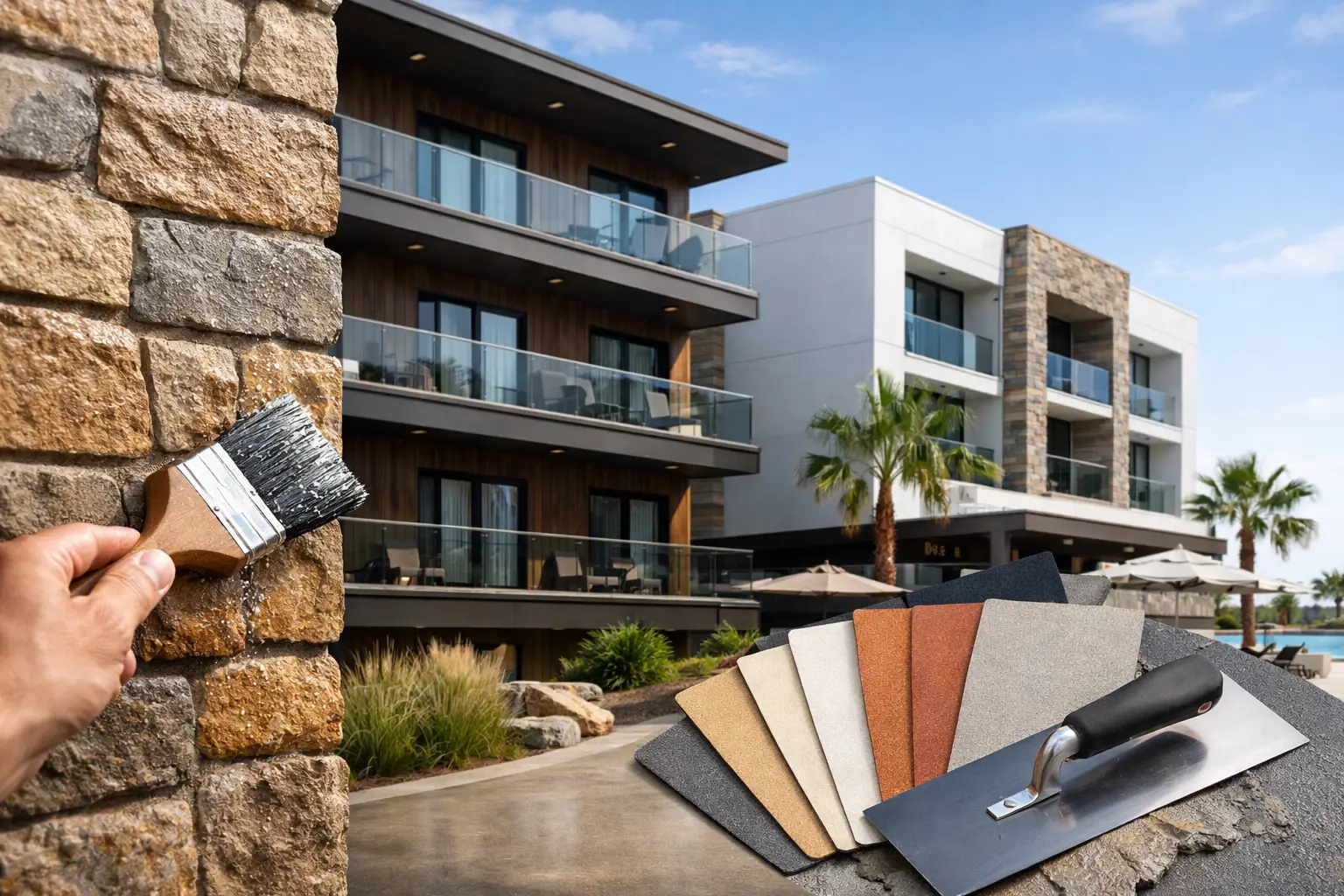
A hotel facade begins working long before a guest enters the lobby. It signals the property’s price point, brand character, and level of care from the street, airport approach, or resort drive. The best finishes for hotel exteriors must therefore do more than photograph well at opening. They must retain color, resist weather and cleaning cycles, support a compliant wall assembly, and remain serviceable through years of high-visibility operation.
For hospitality owners and design teams, finish selection is an envelope decision, not a final decorative choice. A coastal resort, a downtown convention hotel, and a limited-service property beside a highway face entirely different exposure conditions. The right answer comes from matching the finish system, panel material, detailing, and fire-performance requirements to the building’s location and operating model.
What Hotel Exterior Finishes Must Deliver
Hotels are unusually demanding facade projects because their exterior is a permanent part of the guest experience and the operating asset. Unlike many office buildings, a hotel cannot easily hide a stained entrance elevation or postpone repairs until a tenant turnover. The facade is seen daily by arriving guests, event attendees, staff, and online reviewers.
A successful finish specification balances five priorities: long-term color and gloss retention, resistance to moisture and airborne contaminants, cleanability, dent and scratch tolerance, and compatibility with the specified wall assembly. Fire performance belongs in that same discussion. A beautiful panel finish does not establish compliance on its own. On projects where applicable, the complete exterior wall assembly must be evaluated against the governing code and required test evidence, such as NFPA 285, CAN/ULC-S134, BS 8414, or EN 13501 classifications.
The exposure map should guide the specification. South- and west-facing elevations receive the highest UV and thermal load in much of the United States. Porte cocheres, service entries, ground-floor retail zones, and luggage-drop areas need greater abrasion and impact resistance. Pool decks and oceanfront sites require special attention to salt, humidity, fastener selection, drainage, and cleaning practices.
Best Finishes for Hotel Exteriors by Design Goal
High-performance solid colors
Solid colors in premium fluoropolymer coating systems remain one of the most dependable choices for hotel cladding. Whites, warm grays, charcoals, deep blues, and carefully selected neutrals can support brands ranging from select-service to luxury hospitality. Their value is practical as well as visual: a well-specified coil coating provides consistent coverage across large elevations and is generally easier to coordinate with window systems, soffits, signage, and adjacent materials.
For exterior metal panels, PVDF and FEVE-based coating systems are commonly selected where UV stability, chalk resistance, and color retention are central concerns. The best choice depends on the color, substrate, climate, warranty requirements, and available coating architecture. Very dark colors deserve additional scrutiny in high-sun environments because surface temperatures can rise significantly. That thermal movement must be accommodated in panel sizing, joints, attachment design, and installation tolerances.
Solid finishes are particularly effective when the architecture depends on proportion, shadow lines, and panel modulation rather than surface pattern. They also provide a strong baseline for phased construction, since future replacement panels are easier to identify and coordinate when the original color standard is well documented.
Metallic and mica finishes for contemporary urban hotels
Metallic and mica finishes add depth without the maintenance burden associated with untreated metal. They are often used for arrival towers, podium wraps, vertical fins, and feature volumes where a hotel needs a more premium visual signal. Fine metallic effects can shift subtly across changing daylight, helping a large facade read with greater dimension.
This category demands disciplined fabrication and installation. Panel direction, batch control, orientation marks, and consistent viewing angles matter because metallic pigments can create visible variation when panels are mixed or rotated. The specification should state whether directional installation is required and how material from multiple production lots will be controlled.
A restrained metallic finish can be an excellent choice for high-rise hotel projects, particularly when paired with matte fields and clear glazing. Highly reflective finishes may be less suitable near busy streets, neighboring residential towers, or intense desert sunlight, where glare becomes a comfort and planning concern.
Wood-look finishes for warmth without organic-material exposure
Wood-look metal finishes are widely used to bring warmth to hotel exteriors, especially at entrances, terraces, low-rise wings, and resort-style amenity buildings. They can complement stone, stucco, glazing, and landscape while avoiding many of the movement, moisture, pest, and refinishing demands of exterior timber.
Not all wood-look finishes should be treated as interchangeable. The quality of the pattern, repeat length, texture, topcoat, and color variation determines whether the final facade feels architectural or artificial. Large uninterrupted panel runs can reveal repeating graphics, so panel layout should be developed with the finish sample in view. Designers often achieve a more convincing result by limiting wood effects to human-scale zones and combining them with honest metal or mineral finishes across larger masses.
For humid regions and hospitality environments with frequent washdown, wood-look metal can offer a practical balance of biophilic character and manageable maintenance. It still requires correct joint design and drainage. A durable printed finish cannot compensate for water trapped behind a poorly detailed rainscreen.
Stone, concrete, and textured finishes for substantial massing
Stone-look, concrete-look, and textured finishes suit hotels that need a grounded, durable appearance without the weight and installation complexity of full-depth masonry. They are useful on podiums, parking interfaces, conference wings, and branded exterior volumes where a monolithic visual language is desired.
Texture can also help moderate the appearance of minor surface irregularities and reduce glare. However, heavily textured surfaces may collect more dust in arid locations or pollutants in urban corridors. Before finalizing the finish, teams should review cleanability under the property’s actual maintenance program. A facade that looks excellent in a showroom but requires specialized cleaning equipment every few months can create avoidable lifecycle cost.
Where panels are expected to meet sidewalks, valet lanes, or service circulation, use detailing that protects vulnerable edges and establishes a realistic replacement strategy. No finish is immune to vehicle contact, luggage carts, or maintenance equipment at ground level.
Anodized, stainless steel, copper, bronze, and other real-metal expressions
Real-metal surfaces can give landmark hotels an unmistakable identity. Anodized aluminum offers a refined, integral metallic appearance with strong resistance to UV degradation. Stainless steel can support crisp, high-tech, or luxury applications. Copper and bronze develop living surfaces that change over time, creating distinction that coated imitations cannot fully replicate.
The trade-off is predictability. Natural metals weather differently by orientation, runoff patterns, local atmosphere, and contact with adjacent materials. Copper runoff can stain porous surfaces below it. Stainless steel finishes may show fingerprints or water spotting in guest-facing touch zones. Anodized finishes require clear expectations around batch variation and color range.
These materials are best specified when the design team embraces their natural behavior rather than expecting a frozen appearance. Mockups should include corners, joints, transitions, runoff conditions, and adjacent materials, not only flat sample panels.
Fire-Rated Panel Selection Cannot Be an Afterthought
For hotel exterior cladding, finish and core selection must move together. A project team may choose a visually ambitious metallic, wood, or custom color surface, but the panel’s fire classification and the complete wall assembly remain central to approval and risk management.
The appropriate fire-rated panel category depends on the jurisdiction, building height, occupancy, wall configuration, insulation, air and water barrier, cavity details, and code pathway. FR-A1, FR-A2, FR-B1, and FR-B2 designations are not interchangeable, and they should never be selected from appearance alone. Consultants and authorities having jurisdiction will evaluate the specific requirements of the project.
Alubond supports this process with fire-rated ACP and MCM options, solid aluminum panels, and complete facade material capabilities produced through vertically integrated manufacturing. For specification-driven hotel work, that control over mineral cores, coatings, adhesives, and custom finishes helps align design intent with available technical documentation and supply planning.
Specify the Finish as a System, Not a Swatch
A finish schedule should define more than a color name. It should identify the panel substrate, coating type, gloss range, texture, orientation requirements, color standard, acceptable variation, panel direction, protective-film requirements, and cleaning guidance. For custom colors, require approved production samples under exterior viewing conditions. Printed renderings and small interior chips are not sufficient for final decisions.
Full-scale mockups are especially valuable on hotels because facade materials meet so many other elements: glazing, stone, lighting, signage, canopies, louvers, and landscaping. Review the mockup in morning sun, afternoon sun, and artificial evening light. A charcoal finish that feels elegant at noon may appear nearly black at night, while a metallic surface may reveal more contrast than anticipated under grazing illumination.
Maintenance should be discussed before procurement, not after opening. Most coated metal facades benefit from periodic cleaning with methods compatible with the finish and local water conditions. Avoid assuming that rain will clean a facade evenly. Recesses, sheltered soffits, and elevations near exhaust or traffic routes often need a separate cleaning plan.
Choosing for the Hotel’s Real Operating Environment
The strongest hotel facade finish is the one that remains credible after weather, guest traffic, cleaning, and close inspection. Use premium solid or restrained metallic coatings where long-term consistency is the priority. Use wood-look and textured finishes to add warmth or tactility at human scale. Choose real metals when their evolving patina is part of the architectural story, not an unexpected maintenance issue.
The final decision should be tested against the building’s climate, wall assembly, fire requirements, detailing, and ownership horizon. When those factors are resolved together, the exterior can carry the hotel’s identity with the same confidence on year ten as it does on opening day.
RECENT POSTS

September 26 , 2026

September 24 , 2026

September 22 , 2026

September 20 , 2026

September 18 , 2026

September 16 , 2026

September 14 , 2026

September 12 , 2026

September 10 , 2026

September 8 , 2026

September 6 , 2026

September 4 , 2026

September 2 , 2026

August 31 , 2026

August 29 , 2026

August 27 , 2026

August 25 , 2026

August 23 , 2026

August 21 , 2026

August 19 , 2026

August 17 , 2026

August 15 , 2026

August 13 , 2026

August 12 , 2026

August 12 , 2026

August 12 , 2026

August 12 , 2026

August 12 , 2026

August 12 , 2026

August 12 , 2026

August 12 , 2026

November 2 , 2022

April 26 , 2022

