News
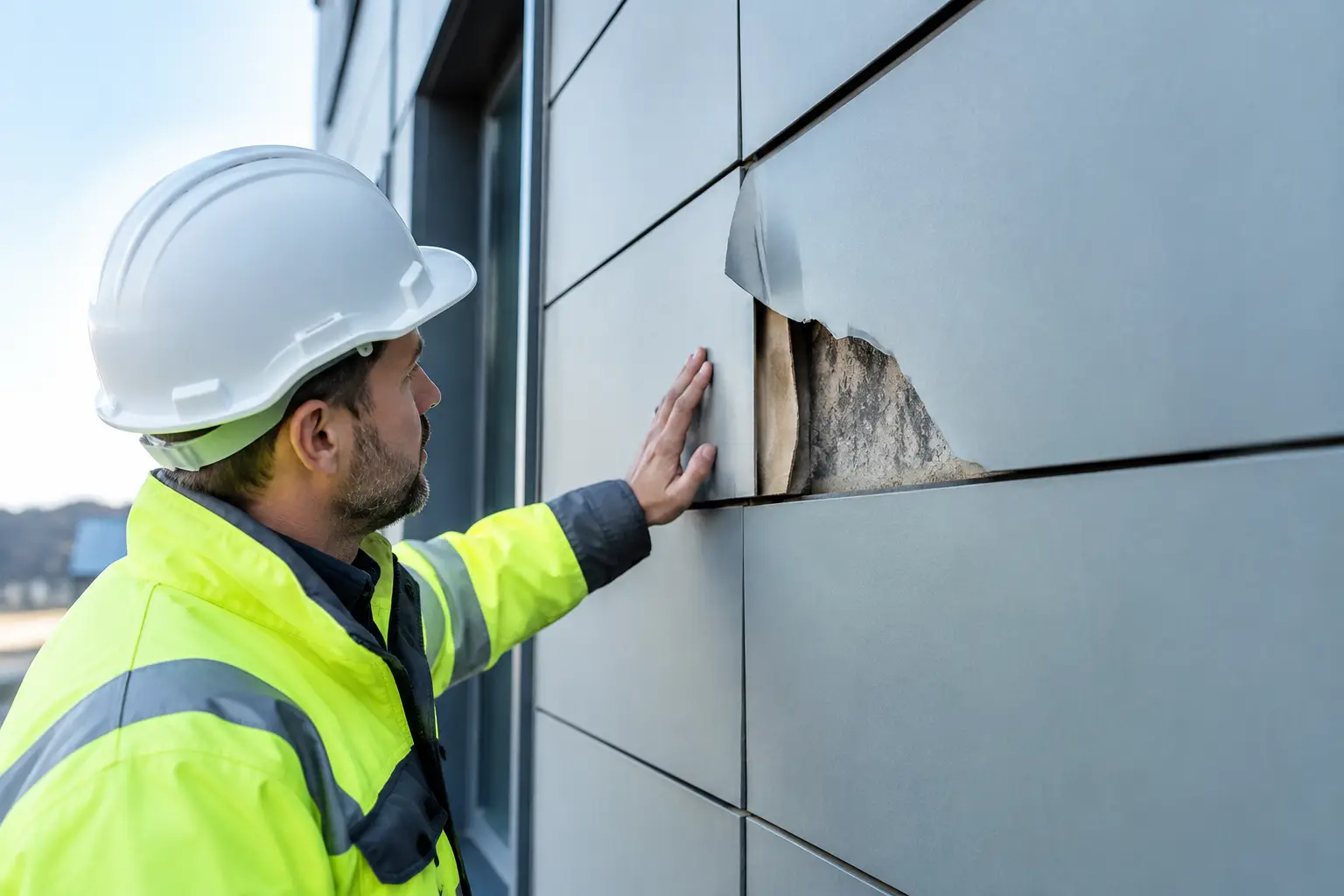
A facade may look sound from the ground while its panel bond is already losing integrity behind the finished surface. For architects, contractors, and owners, the question is not simply why do facade panels delaminate, but whether the condition is isolated, progressing, or connected to a larger building-envelope failure. Early diagnosis protects appearance, weather resistance, public safety, and the long-term value of the asset.
Delamination is not a single defect with a single cause. In composite facade panels, it describes separation between bonded layers, most commonly the decorative metal skin, adhesive layer, and core. The visible symptom may be local bubbling, oil-canning, a hollow sound during tapping, lifted edges, or a panel face that no longer lies flat. The underlying mechanism can originate in material selection, manufacturing, fabrication, installation, or exposure conditions.
Why Do Facade Panels Delaminate?
A composite panel is engineered as a layered construction. Its performance depends on the continuous bond between each layer, not merely on the thickness or appearance of the outer metal skin. When that bond is weakened, the panel can lose stiffness, flatness, and resistance to wind cycling.
The most common pathway is a combination of stress and a compromised bond. Moisture may enter at an unsealed edge or failed joint. Thermal movement may repeatedly load the panel. Fabrication may create localized stress or expose vulnerable edges. If the adhesive system, core, coating, or installation method is not suited to the project conditions, those forces can gradually separate the assembly.
A useful investigation begins by separating the observed symptom from the root cause. A bulge at the center of a panel, for example, may reflect adhesive degradation. A lifted corner may instead point to water entry, insufficient edge return, incompatible sealant, excessive fastener restraint, or distortion introduced during fabrication.
Moisture Entry and Edge Exposure
Water is a persistent cause of delamination because it can travel farther than the visible stain or open joint suggests. Composite panels are generally protected across their finished faces, but cut edges, routed areas, drilled penetrations, damaged coatings, and poorly detailed transitions require particular attention.
If water reaches a bond line, it may reduce adhesive strength over time. Freeze-thaw cycling can intensify the problem where absorbed or trapped moisture expands. Capillary action at horizontal joints, unprotected panel edges, window perimeters, parapets, and penetrations can create repeated wetting even when the primary facade surface appears dry.
This does not mean every panel installation must be fully sealed at every location. Many rainscreen systems depend on drained and ventilated cavities rather than face-sealing alone. The critical issue is whether the system manages water intentionally: flashings must direct it outward, joints must accommodate movement, cavity drainage must remain open, and exposed panel edges must follow the panel manufacturer’s approved detailing.
Thermal Movement and Differential Expansion
Facade materials move as temperatures change. Aluminum expands and contracts at a different rate than mineral cores, fasteners, framing, sealants, and adjacent construction. Dark colors and high-solar-exposure elevations can experience substantially higher surface temperatures than shaded portions of the same building.
Movement becomes destructive when the panel is restrained beyond the limits of its fabrication and attachment design. A panel that cannot expand can transfer stress into folded returns, routed corners, fastener points, and bond lines. Repeated daily and seasonal cycling may then fatigue the system.
Panel dimensions, color selection, orientation, joint width, support spacing, and fixing method all affect this risk. Long panels with minimal joint allowance demand more careful engineering than smaller, regularly supported modules. The right answer depends on the panel material and attachment system, but the principle is constant: the facade must permit predictable movement rather than forcing the panel to resist it.
Adhesive, Core, and Manufacturing Quality
Not all composite panels are built with the same bonding technology or process control. Bond performance depends on compatible materials, controlled adhesive application, surface preparation, pressure, temperature, cure conditions, and inspection during production. A weak or inconsistent bond may not become visible until the panel is exposed to exterior heat, wind pressure, moisture, and time.
Contamination is another concern. Oils, dust, moisture, or improper treatment of the metal coil can interfere with adhesion. Inadequate bonding coverage can leave localized areas vulnerable to blistering or separation. The risk may be higher where a project uses panels from an unknown source, mixed production lots, or materials without clear technical documentation and traceability.
For specification-driven projects, panel selection should consider more than finish and nominal thickness. Request the manufacturer’s technical data, recommended fabrication procedures, warranty terms, and evidence that the proposed panel is appropriate for the intended exposure and system. Fire classification and wall-assembly compliance should also be evaluated independently and as part of the full facade design. A fire-rated core does not eliminate the need for durable bonding, drainage, movement accommodation, and correct installation.
Fabrication Damage Can Start the Failure
Many field delamination cases begin before the panels arrive on site. Routing too deeply can damage the back skin or reduce the material left at a fold. Tight folding radii can crack coatings or overstress the bond near corners. Chips, scratches, uncontrolled heat, and improper handling can expose surfaces that later admit moisture.
Fabricators should use approved routing depths, tooling, bending practices, and edge treatments for the specific panel construction. Protective films should be removed according to the manufacturer’s instructions. Leaving film on beyond the recommended period can create finish problems, while premature removal can increase the chance of handling damage.
Storage matters as well. Panels should be kept dry, supported evenly, and protected from standing water, prolonged direct sun under protective film, and impact. A distorted panel can be difficult to install without adding stress to the assembly.
Installation Stresses and Incompatible Materials
Installation can turn a manageable material characteristic into a failure mechanism. Over-tightened fasteners, improperly located fixing points, inadequate support rails, and uneven substrates can force panels out of plane. The resulting stress may show up first at corners and returns, then extend across the face.
Sealants, tapes, cleaners, and touch-up products must be compatible with the panel coating and adjacent components. Chemical incompatibility can stain finishes, soften materials, or affect bond zones near joints. Field modifications should never be assumed harmless simply because they are concealed after installation.
Wind loading deserves equal attention. Panels and their subframing must be engineered for project-specific wind pressures, including higher local pressures at corners, parapets, and roof zones. A panel may remain attached while still experiencing cyclic deflection that contributes to progressive bond fatigue. System design, fastener selection, support spacing, and installation quality must work together.
How to Investigate Suspected Delamination
A proper assessment starts with a close visual survey. Document locations, elevation, orientation, panel color, joint condition, water paths, impact damage, and the relationship to penetrations or transitions. Map the issue rather than treating each visible bubble as an unrelated event.
Non-destructive methods such as tap testing, infrared review under suitable conditions, and focused moisture investigation can help identify the extent of separation. Selective removal may be necessary to inspect the panel back, adhesive interface, cavity conditions, drainage plane, and subframing. Any sampling plan should preserve evidence of panel identification, production information, fabrication details, and installation conditions.
Do not assume replacement alone resolves the defect. Replacing a visibly damaged panel without correcting an open flashing, restrained joint, fabrication practice, or incompatible material can produce the same failure again. The repair scope should address both the failed component and the mechanism that caused it.
Prevention Begins at Specification
The most reliable prevention strategy is to treat composite cladding as a system, not as a finish layer. Specify panel type, thickness, core classification, coating, fabrication limits, attachment approach, drainage requirements, joint geometry, and movement provisions in coordinated documents. Require submittals that demonstrate the proposed materials and assembly meet the project’s code, performance, and environmental demands.
Mockups are particularly valuable for large or complex facades. They allow the project team to evaluate panel flatness, routing and folding quality, joint behavior, sealant compatibility, water management, and installation sequencing before the work is repeated across thousands of square feet. For demanding projects, a manufacturer with controlled production of core materials, bonding systems, coated coils, and finishes can provide a stronger basis for consistency and technical accountability.
When a facade shows early signs of delamination, act before the condition becomes a broad replacement program. A disciplined review of water, movement, manufacturing, fabrication, and installation will identify the right corrective path and help preserve the architectural intent of the building for decades.
RECENT POSTS

September 22 , 2026

September 20 , 2026

September 18 , 2026

September 16 , 2026

September 14 , 2026

September 12 , 2026

September 10 , 2026

September 8 , 2026

September 6 , 2026

September 4 , 2026

September 2 , 2026

August 31 , 2026

August 29 , 2026

August 27 , 2026

August 25 , 2026

August 23 , 2026

August 21 , 2026

August 19 , 2026

August 17 , 2026

August 15 , 2026

August 13 , 2026

August 12 , 2026

August 12 , 2026

August 12 , 2026

August 12 , 2026

August 12 , 2026

August 12 , 2026

August 12 , 2026

August 12 , 2026

November 2 , 2022

April 26 , 2022

