News
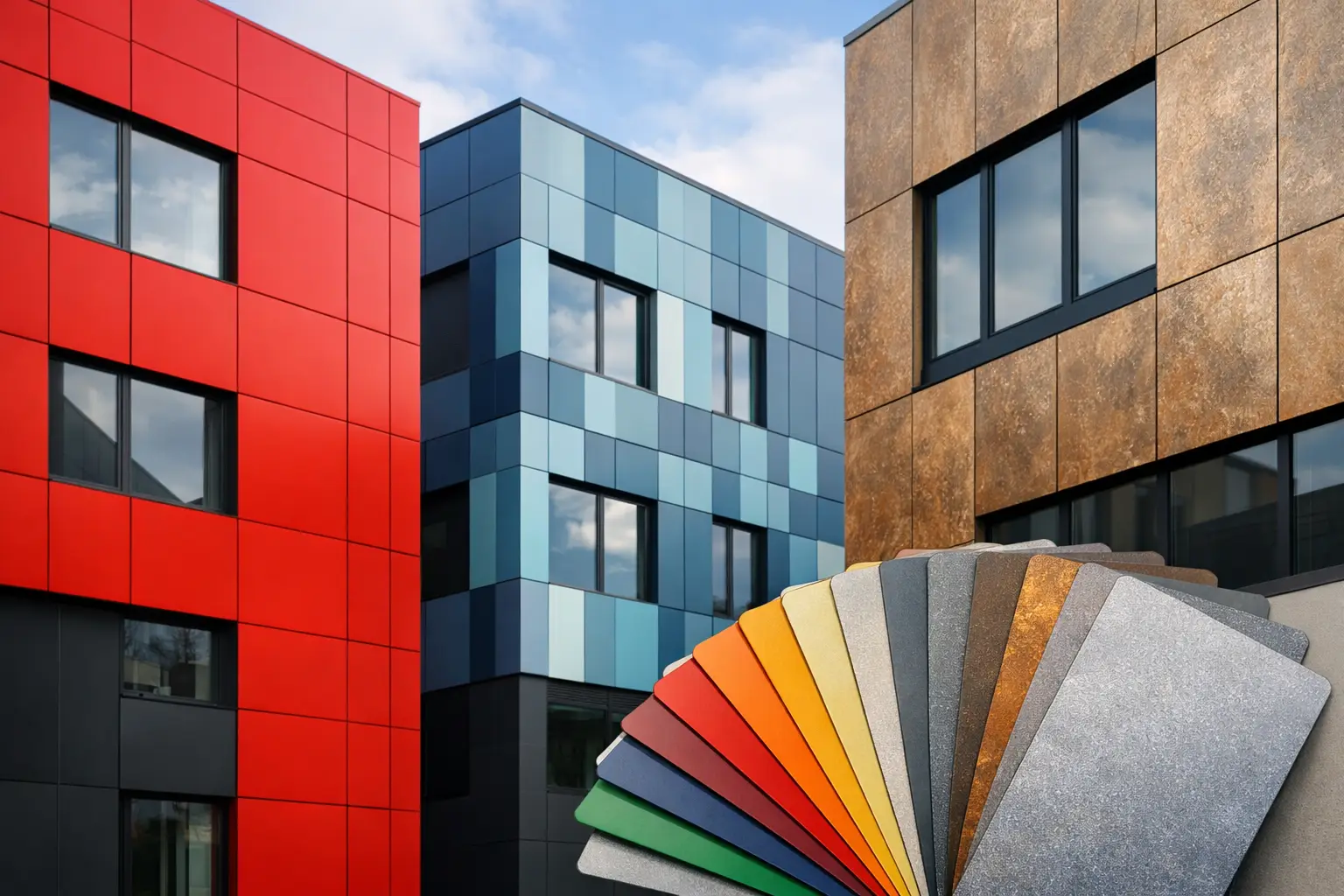
A custom finish is not a decorative decision made at the end of facade design. On a tower, airport, hospitality complex, or corporate headquarters, custom color facade panel finishes determine how a building reads from the street, how consistently it presents across elevations, and how well that appearance endures through years of UV exposure, weather, and maintenance.
For architects and project teams, the opportunity is substantial: a facade can carry a brand color, respond to a regional context, reproduce the depth of natural materials, or establish a signature visual identity. The discipline lies in specifying the finish as part of the complete building-envelope system, with performance criteria that are as clear as the color target.
Custom Color Facade Panel Finishes Start With Intent
A custom color request should begin with the architectural objective, not merely a paint code. A deep corporate blue may need to look uniform across a broad rainscreen elevation. A metallic champagne finish may need controlled sparkle without visible directional variation. A wood-look or stone-effect panel may need pattern variation that avoids repetition across large walls.
These are different finish challenges, and they require different approaches to pigment selection, coating chemistry, gloss level, coil coating controls, panel orientation, and fabrication planning. A color that appears correct on a small sample can behave very differently over thousands of square feet, especially where changing daylight reveals differences in sheen or reflectance.
The specification should identify whether the visual priority is exact brand matching, metallic depth, low-gloss restraint, material realism, or contrast between facade zones. This early clarity prevents a common project problem: approving an isolated color chip, then discovering that the installed facade does not deliver the intended scale or visual effect.
Color Is Only One Part of the Finish System
Exterior panel finish performance depends on the full coating system. The topcoat provides the visible color and surface character, while pretreatment, primer, coating thickness, curing, and substrate quality influence adhesion, corrosion resistance, and long-term durability. These layers must perform together.
For demanding exterior applications, fluoropolymer-based coating systems are often selected for their resistance to UV degradation, chalking, fading, and weathering. The appropriate system still depends on the project location, elevation, orientation, color family, and expected service environment. A coastal project with salt exposure has different risks than an inland office building. A desert facade faces intense solar load and temperature cycling. Urban industrial environments can introduce atmospheric contaminants that affect maintenance and finish longevity.
Dark colors deserve special attention. They can create dramatic monolithic elevations, but they absorb more solar energy and may reach higher surface temperatures. That increases the importance of panel flatness, substrate selection, fabrication tolerances, joint design, and allowance for thermal movement. The right answer is not to avoid dark colors. It is to engineer the panel system for the conditions it will face.
Gloss also changes performance perception. High-gloss finishes can intensify color and reflectivity, but they reveal oil-canning, handling marks, and variations in substrate flatness more readily. Matte and low-gloss surfaces can create a refined architectural appearance while reducing visible reflection, though they require careful cleaning guidance because some surface textures can retain dirt more easily.
Metallics Need Orientation Control
Metallic and mica finishes bring movement and depth to a facade, but they require stricter installation discipline than solid colors. The flakes or pigments within the coating can reflect light differently when panels are rotated, mixed between production lots, or installed in inconsistent directions.
Specification documents should establish a defined panel orientation and require installers to maintain it across the elevation. Where possible, material should be ordered as a coordinated project run, with batch control and clear labeling. Mockups are particularly valuable for metallic finishes because they allow the design team to review the appearance at realistic panel sizes, joint conditions, and viewing angles.
Natural-Material Effects Require a Repeat Strategy
Wood, stone, concrete, brushed metal, copper, bronze, and other expressive finishes can deliver the visual richness of premium materials with the fabrication advantages of composite and solid metal panels. However, realism depends on scale. Repeating a small graphic pattern across a large elevation can look artificial, even when the sample is convincing.
Project teams should review pattern repeat lengths, panel sequencing, corner conditions, and the relationship between adjacent panels. The intended effect may call for controlled variation rather than exact uniformity. That decision should be documented before fabrication begins, especially for elevations where panels are viewed at close range.
Specify the Facade, Not Just the Panel
A finish cannot be evaluated in isolation from the wall assembly. Custom-painted panels may be available across fire-rated aluminum composite panel configurations, metal composite materials, and solid aluminum solutions, but the selected product must align with the project’s code path and tested wall assembly requirements.
For projects requiring specific fire performance, the panel classification, insulation, air and water barrier, attachment system, cavity treatment, and perimeter fire containment all matter. A visually ambitious facade still requires a system approach supported by applicable documentation and assembly testing, including standards such as NFPA 285, EN 13501, BS 8414, or CAN/ULC-S134 where relevant to the jurisdiction and project scope.
This is especially critical when a custom finish is applied to a panel selected for a high-rise, healthcare, hospitality, transportation, or other compliance-sensitive application. The finish selection should not inadvertently change the specified product construction, coating standard, or documented assembly configuration. Coordinate early with the manufacturer, facade consultant, and authority having jurisdiction when the project demands a tested system.
Alubond supports this coordination through vertically integrated manufacturing that includes coated coils, custom paints, fire-retardant mineral cores, adhesives, and panel production. For specification teams, that level of production control matters because finish development, panel construction, and supply planning can be addressed as connected requirements rather than separate procurement problems.
The Approval Process Should Reflect Real Conditions
A digital rendering is useful for exploring color direction, but it is not a finish approval. Screen calibration, lighting, image processing, and adjacent materials all affect perceived color. The reliable process moves from preliminary sample to larger control sample, then to a project-specific facade mockup when the design or exposure conditions warrant it.
The mockup should include representative panel sizes, joints, folds, corners, trims, sealants, and adjacent materials. Review it outdoors at more than one time of day. A finish that appears calm under overcast light may become highly reflective in direct sun. A color that looks neutral next to white glazing frames may appear warmer beside limestone, precast concrete, or bronze anodized components.
Approval criteria should be practical and explicit. Define the approved color standard, gloss range, texture, metallic direction where applicable, allowable visual variation, viewing distance, panel orientation, and acceptable fabrication details. The goal is not to demand impossible perfection from an industrial material. It is to establish a controlled, repeatable standard that protects the architectural intent.
Plan Quantity, Fabrication, and Replacement Material Early
Custom colors are most successful when procurement is planned before the facade is released to fabrication. Project teams should confirm total quantity, overage, phased-delivery requirements, and the need for attic stock. This is particularly important for colors with special pigments, multi-layer effects, printed patterns, or limited production runs.
Fabricators also need finish-specific handling practices. Protective films, bending methods, routing procedures, storage conditions, and cleaning products should be compatible with the selected coating. A high-performance finish can still be damaged by abrasive cleaning, improper stacking, trapped moisture, or careless removal of protective film after prolonged site exposure.
Replacement panels present another reason to plan ahead. Even a durable exterior coating changes subtly over time as the facade weathers. Keeping approved attic stock from the original production run can reduce visible mismatch if future repairs are needed. For large public-facing facades, this small procurement decision can preserve a building’s appearance for years.
Design Freedom Works Best With Technical Discipline
Custom color allows a facade to become more than enclosure. It can establish identity, scale a building appropriately for its setting, and turn a demanding elevation into a recognizable architectural asset. But the strongest result comes from balancing visual ambition with material science, wall-system compliance, and disciplined quality control.
Bring the finish conversation forward, review it at full scale, and connect it to the actual performance demands of the building. That is how a custom color becomes a controlled facade specification rather than a late-stage visual preference.
RECENT POSTS

September 26 , 2026

September 24 , 2026

September 22 , 2026

September 20 , 2026

September 18 , 2026

September 16 , 2026

September 14 , 2026

September 12 , 2026

September 10 , 2026

September 8 , 2026

September 6 , 2026

September 4 , 2026

September 2 , 2026

August 31 , 2026

August 29 , 2026

August 27 , 2026

August 25 , 2026

August 23 , 2026

August 21 , 2026

August 19 , 2026

August 17 , 2026

August 15 , 2026

August 13 , 2026

August 12 , 2026

August 12 , 2026

August 12 , 2026

August 12 , 2026

August 12 , 2026

August 12 , 2026

August 12 , 2026

August 12 , 2026

November 2 , 2022

April 26 , 2022

