News
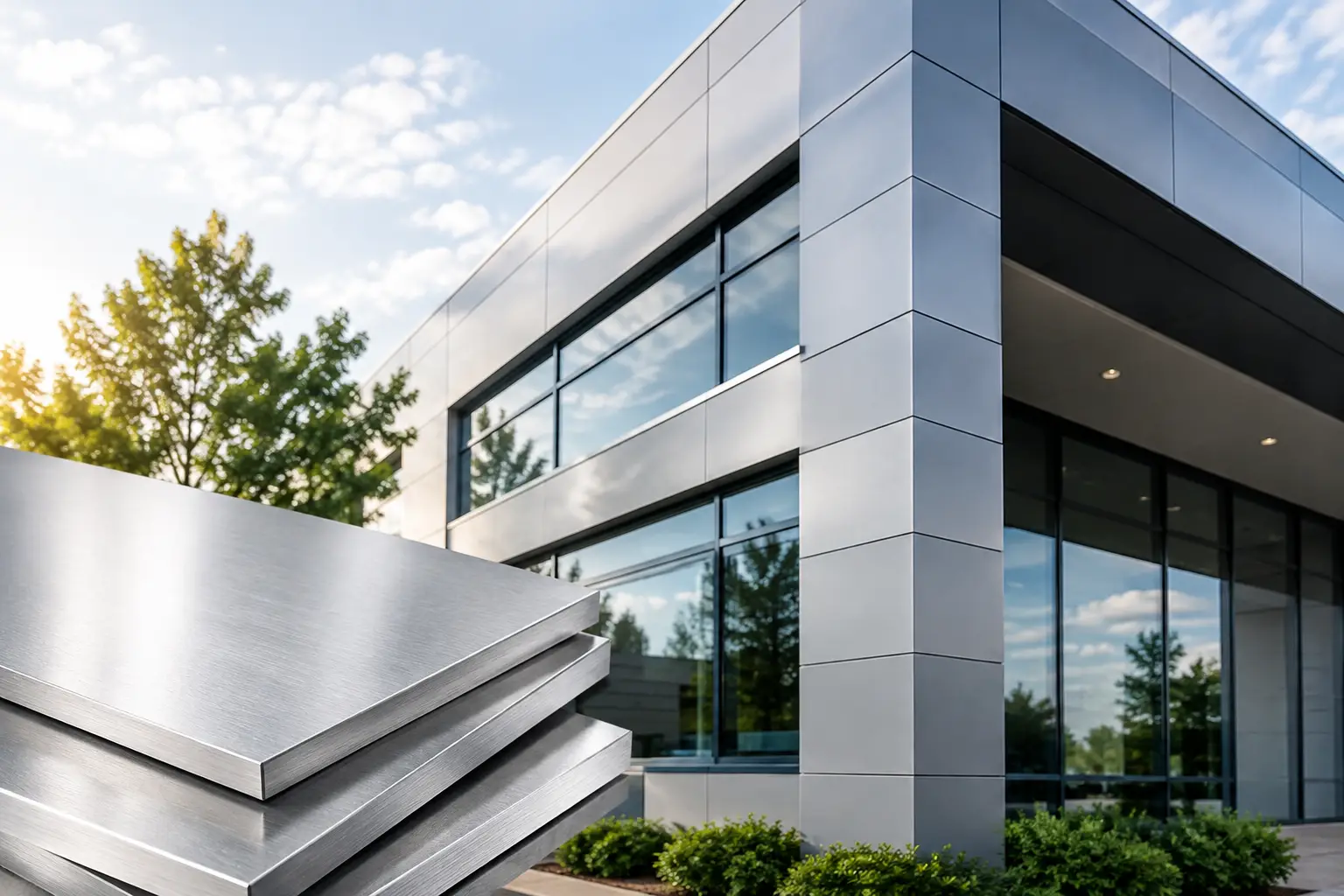
A facade material can look exceptional in a rendering and still create avoidable risk in fabrication, installation, or long-term appearance. This solid aluminum review examines what solid aluminum panels deliver on commercial exterior walls, where they require disciplined detailing, and how project teams should evaluate them against architectural intent, code requirements, and installation realities.
What Solid Aluminum Panels Are
Solid aluminum panels are formed from a single aluminum sheet rather than from two metal skins bonded to a core. For exterior cladding, the sheet is typically fabricated into cassette panels, routed and folded return panels, brake-formed elements, soffits, column covers, or custom profiles. The visible face can receive a high-performance coating, anodized finish, metallic paint, woodgrain effect, or project-specific custom color.
The distinction matters. Aluminum composite material and metal composite material offer high flatness at low weight because their construction combines thin metal skins with a core. Solid aluminum has a different performance profile. It provides a monolithic metal face, offers a direct material path for certain noncombustible wall concepts, and can be formed into durable architectural components without relying on a composite core.
For a high-rise podium, airport canopy, hospital entrance, retail facade, or exposed soffit, solid aluminum can be the right answer. It is not automatically the best answer for every elevation. Large, perfectly planar fields and highly cost-sensitive applications may favor other panel technologies.
Solid Aluminum Review: The Performance Case
The central benefit of solid aluminum is material simplicity. The panel face, returns, and formed geometry are made from one metal sheet. This makes solid aluminum a strong candidate where architects want crisp folded edges, deep reveals, perforated patterns, sculptural forms, or a high-value metal appearance across complex facade geometry.
Aluminum also brings a favorable strength-to-weight relationship. It is substantially lighter than many steel-based cladding options, reducing handling demands and helping fabricators produce large-format components within the limits of the support system. Its inherent corrosion resistance supports exterior use in many climates, provided the alloy, coating system, fasteners, and dissimilar-metal interfaces are selected correctly.
The material is also highly recyclable. For developers and owners pursuing responsible material strategies, recycled content, end-of-life recovery, regional manufacturing, and documented environmental attributes should be addressed through the specific product submittal rather than assumed from the base metal alone.
Fire performance must be evaluated as a system
Solid aluminum is often selected because it can support a noncombustible material approach. That is a meaningful advantage, but it is not a substitute for wall-assembly analysis. Exterior-wall fire performance depends on the complete system: insulation, air and water barrier, cavity configuration, attachments, perimeter fire containment, framing, glazing interfaces, and installation quality.
A metal panel may perform differently from the assembly behind it during a fire event. Aluminum also loses strength at elevated temperatures and can deform under severe heat exposure. Project teams should therefore align panel selection with applicable code provisions, authority having jurisdiction requirements, and tested assembly documentation where required. For multistory construction, references such as NFPA 285, EN 13501, BS 8414, and CAN/ULC-S134 must be reviewed in the context of the specified wall configuration, not treated as interchangeable product labels.
Where Solid Aluminum Requires More Attention
The trade-off for a single-sheet metal panel is visible flatness. Aluminum moves with temperature change, and thin or oversized panels can display oil canning, waviness, or read-through from supports. Oil canning is an optical condition, not necessarily a structural defect, but it becomes highly noticeable on dark colors, gloss finishes, broad flat panels, and elevations with raking sunlight.
A specification that calls for “flat panels” without defining acceptable visual criteria leaves too much to interpretation. Architects, facade consultants, and fabricators should establish panel dimensions, sheet thickness, stiffening strategy, joint layout, finish gloss level, viewing distance, and lighting conditions before production begins.
Thickness alone does not solve the issue. A heavier sheet can improve panel behavior, but formed returns, internal stiffeners, rail locations, cassette depth, and attachment spacing all influence the finished appearance. Larger panels may require more deliberate engineering and a different visual expectation than smaller modular units.
Thermal expansion also needs room to occur. Fixed points and sliding points should be clearly coordinated so panels can move without distortion, fastener stress, joint closure, or audible movement. This is especially relevant on long elevations facing high solar exposure or regions with wide annual temperature ranges.
Finish Selection Is a Technical Decision
Color is not merely an aesthetic choice on solid aluminum. It affects thermal loading, visible waviness, maintenance expectations, and perceived facade quality. Very dark finishes absorb more heat, while high-gloss surfaces can amplify minor imperfections. Metallic and mica finishes can create variation between panels if batch control, orientation, and installation sequencing are not managed carefully.
For most demanding exterior applications, project teams should specify a coating system appropriate to exposure, warranty expectations, and local environmental conditions. Coastal locations, industrial corridors, desert climates, and high-UV regions may need additional consideration for coating performance, edge treatment, salt exposure, and cleaning schedules.
Finish samples should be reviewed at meaningful scale and under exterior light. A small chip does not show the same reflectivity, texture, panel-to-panel variation, or directional effect that appears across a full facade. For custom colors, approved control samples and batch traceability are practical safeguards, particularly on phased projects.
Fabrication and Detailing Determine the Result
A well-engineered solid aluminum panel can be exceptionally precise. A poorly coordinated one can show distorted corners, inconsistent joints, staining at fasteners, and water-management failures. The panel cannot compensate for incomplete details.
Fabricators should confirm the selected alloy and temper are suitable for the intended forming method. Tight radii, deep returns, perforations near bends, welded features, and complex three-dimensional geometry all affect material selection. Routing and folding, press-brake forming, welding, and mechanical assembly each introduce different constraints.
Panel joints must do more than create a shadow line. They must accommodate thermal movement, drain incidental water, protect vulnerable edges, and coordinate with the air and water barrier plane. Open-joint rainscreen systems require a properly designed secondary weather-resistive layer. Sealed joints require compatible sealants, joint dimensions that allow movement, and substrate conditions that support adhesion.
Dissimilar-metal contact deserves equal attention. Copper, carbon steel, and certain fastener choices can create corrosion concerns when moisture is present. Isolation materials, compatible hardware, drainage, and ventilation should be included in the detail rather than addressed as a field correction.
How to Specify Solid Aluminum with Confidence
A productive solid aluminum specification starts with performance criteria, then connects those criteria to panel geometry and tested system requirements. Naming a finish and a nominal thickness is not enough for a complex facade.
The submittal package should identify the aluminum alloy, temper, sheet thickness, coating type, color designation, gloss range, panel dimensions, return depth, stiffeners, attachment method, joint design, and allowable thermal movement. It should also address wind-load design, deflection criteria, water management, corrosion protection, and fire-related assembly requirements.
Mockups are particularly valuable when the design includes dark colors, metallic finishes, wide panels, perforations, curved forms, or transitions between solid aluminum and other materials. A performance mockup can verify drainage, pressure behavior, attachment coordination, and perimeter interfaces. A visual mockup establishes the appearance standard before hundreds or thousands of panels are released.
For projects that need both rated composite panels and solid metal components, working with a manufacturer that understands the broader envelope is an advantage. Alubond supports facade teams with solid aluminum, fire-rated panel options, custom finishes, and industrial-scale manufacturing capability across international project requirements.
When Solid Aluminum Is the Right Choice
Solid aluminum is especially compelling where the design calls for formed architectural expression, noncombustible material considerations, custom geometries, durable coated metal surfaces, or integrated elements such as soffits, fascia, louvers, and column enclosures. It can create a unified envelope language when paired carefully with glazing, stone, terracotta, metal composite panels, or other rainscreen materials.
It may be less efficient where the priority is maximum flatness over very large panel dimensions, the budget cannot support detailed fabrication, or the support system cannot accommodate the required movement and stiffening strategy. In those cases, a composite panel, alternative metal skin, or revised module may produce a better balance of appearance and cost.
The most useful question is not whether solid aluminum is better than every other cladding material. It is whether its material behavior, fabrication method, fire strategy, finish, and panel module are aligned before the first sheet is cut. When those decisions are made early, solid aluminum gives ambitious architecture a facade that performs as deliberately as it looks.
RECENT POSTS

November 9 , 2026

November 7 , 2026

November 5 , 2026

November 3 , 2026

November 1 , 2026

October 30 , 2026

October 28 , 2026

October 26 , 2026

October 24 , 2026

October 22 , 2026

October 20 , 2026

October 18 , 2026

October 16 , 2026

October 14 , 2026

October 12 , 2026

October 10 , 2026

October 8 , 2026

October 6 , 2026

October 4 , 2026

October 2 , 2026

September 30 , 2026

September 28 , 2026

September 26 , 2026

September 24 , 2026

September 22 , 2026

September 20 , 2026

September 18 , 2026

September 16 , 2026

September 14 , 2026

September 12 , 2026

September 10 , 2026

September 8 , 2026

September 6 , 2026

September 4 , 2026

September 2 , 2026

August 31 , 2026

August 29 , 2026

August 27 , 2026

August 25 , 2026

August 23 , 2026

August 21 , 2026

August 19 , 2026

August 17 , 2026

August 15 , 2026

August 13 , 2026

August 12 , 2026

August 12 , 2026

August 12 , 2026

August 12 , 2026

August 12 , 2026

August 12 , 2026

August 12 , 2026

August 12 , 2026

November 2 , 2022

April 26 , 2022

