News
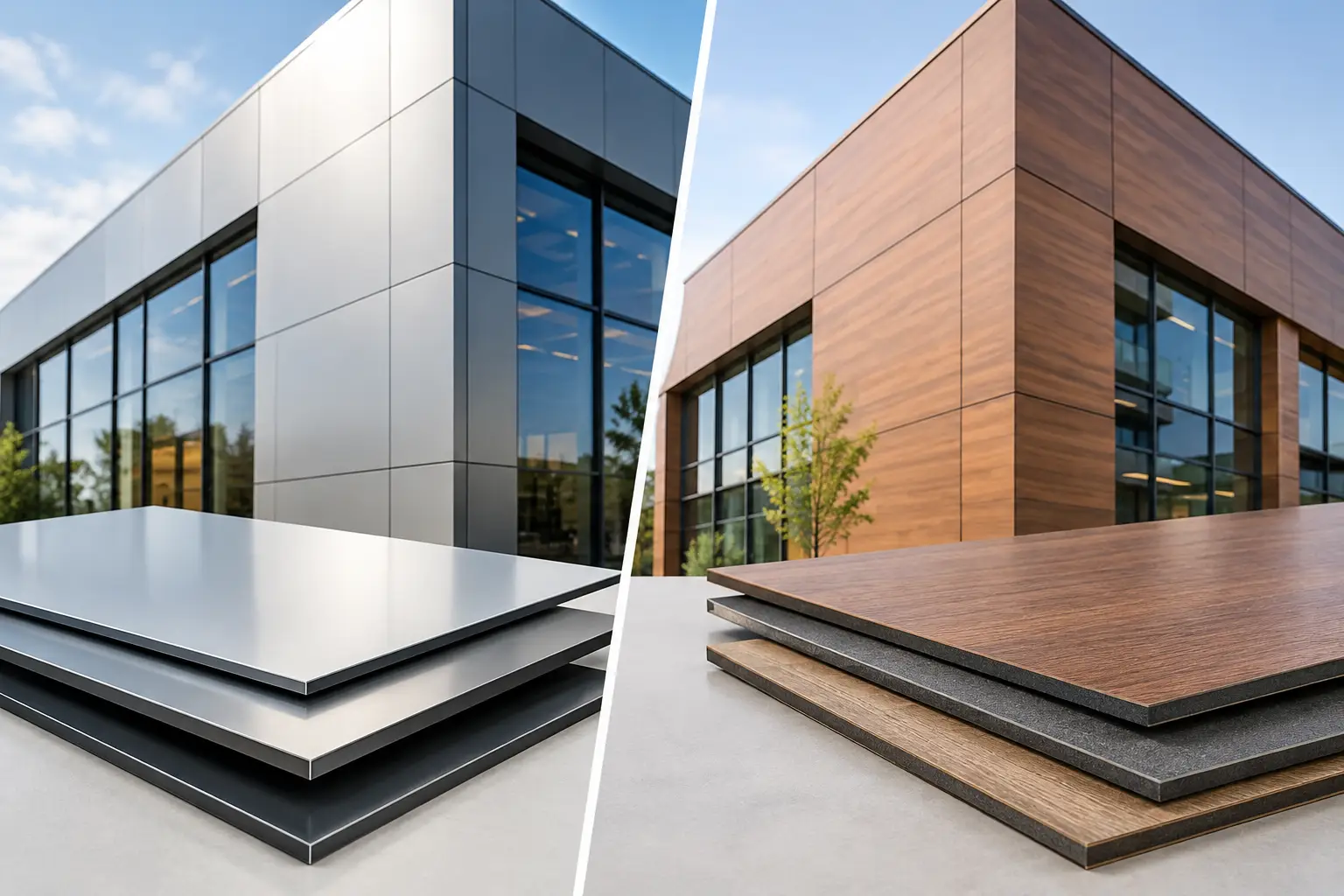
A facade specification can appear settled until the material review begins. ACM versus HPL panels is not simply a comparison of two rainscreen finishes. It is a decision that affects fire strategy, subframe detailing, panel geometry, visual intent, fabrication workflow, maintenance planning, and the evidence required for code approval.
For commercial buildings, the right answer depends on the wall assembly and the project risk profile. ACM can provide exceptionally flat metal surfaces, refined folds, and extensive finish control. HPL offers a distinctly different material expression with high-impact decorative surfaces and compact, solid-panel construction. Neither material should be selected from a color chip or a unit-price comparison alone.
ACM Versus HPL Panels: The Core Material Difference
Aluminum composite material, commonly called ACM or ACP, consists of two aluminum skins bonded to a core. The core formulation is central to fire performance. Exterior ACM is available with different core classifications, from standard polyethylene-based cores to fire-retardant mineral-filled cores designed for higher-performance applications. The panel is lightweight relative to many solid cladding materials and can be routed, folded, curved, and fabricated into cassette, tray, and rainscreen panel systems.
High-pressure laminate, or HPL, is a dense panel produced by pressing layers of cellulose-based paper and thermosetting resins under heat and pressure. Exterior-grade HPL typically uses a protective weather-resistant surface layer over a decorative face. It is generally installed as a solid panel with visible or concealed fastening methods, depending on the system.
The practical distinction is immediate on a facade elevation. ACM reads as metal: clean planes, crisp returns, long directional surfaces, and custom metallic, solid, stone, wood, or specialty finishes. HPL has more visual depth and a material character often associated with woodgrain, natural textures, and graphic decorative surfaces. Both can support strong architectural concepts, but they do not detail, perform, or age in exactly the same way.
Fire Performance Must Be Evaluated as an Assembly
Fire performance is often the deciding factor, especially on high-rise, hospitality, healthcare, airport, mixed-use, and densely occupied projects. A panel’s individual classification is useful, but it is not a substitute for evaluating the complete exterior wall assembly.
For ACM, specifications should identify the required core classification and confirm whether the proposed system has the appropriate evidence for the project. Depending on the code path, jurisdiction, wall construction, insulation, air and water barrier, cavity configuration, and building height, that evidence may include NFPA 285, CAN/ULC-S134, BS 8414, EN 13501, or other applicable testing and engineering documentation. A fire-rated ACM panel installed in an unverified assembly does not automatically establish compliance.
HPL also requires disciplined review. Its resin-based composition, thickness, attachment system, cavity barriers, insulation, and assembly configuration all influence facade fire behavior. HPL products are available in varying performance grades, but no generic statement that a panel is “fire rated” is enough for a specification-driven project.
The key question is not which panel category is universally safer. The question is whether the exact proposed wall build-up satisfies the code and the authority having jurisdiction. Architects and facade consultants should require matching documentation early, before finishes are approved and procurement is underway.
Design Freedom and Fabrication Options
ACM has a major advantage where the design calls for formed geometry. Fabricators can rout and return panel edges, produce cassettes with concealed attachments, create reveals, wrap columns, form soffits, and develop curved or faceted surfaces. Large panel modules can reduce visible joints while retaining a precise, flat appearance. Custom-painted finishes and specialty metal skins broaden the available aesthetic range further.
This flexibility is particularly valuable on corporate headquarters, premium retail, transportation facilities, towers, and hospitality projects where the facade must carry a disciplined visual language across broad elevations. ACM can also integrate effectively with adjacent metal components such as copings, trims, sunshades, and signage bands.
HPL is generally better suited to planar rainscreen compositions. It can deliver compelling wood-look and graphic finishes without the maintenance demands associated with natural wood, and it performs well in applications where an expressed fastening pattern or panel grid supports the architecture. Schools, recreational facilities, low- to mid-rise multifamily buildings, and selected commercial developments often use HPL to introduce warmth or texture into the exterior envelope.
However, HPL does not offer the same folding and edge-return capability as ACM. A design that depends on deep cassette edges, sharp folded corners, or continuous curved cladding will usually favor ACM. Conversely, a design based on flat, durable decorative boards may favor HPL.
Durability, Movement, and Water Management
Both materials can perform successfully in exterior rainscreen systems when the detailing respects their movement characteristics and installation requirements. This is where generic substitutions create risk.
ACM has aluminum faces and responds to thermal change as a metal composite panel. Attachment systems must allow for panel movement while preserving joint alignment and avoiding oil-canning, distortion, or fastener-related stress. Correct panel size, support spacing, joint design, and fabrication tolerances matter, particularly on long elevations exposed to strong temperature swings.
HPL also expands and contracts with changes in temperature and moisture. Its movement can be more directional than metal-based cladding, so fastener locations, fixed points, sliding points, edge clearances, and ventilation gaps must follow the approved system details. Improperly restrained HPL may bow, crack around fasteners, or develop irregular joint conditions.
Neither ACM nor HPL is the weather barrier. The exterior cladding manages solar exposure and sheds much of the rain, while the air and water barrier behind it provides the primary line of water control. A drained and ventilated cavity, correctly designed flashings, protected openings, compatible sealants, and tested interfaces are essential regardless of panel type.
Maintenance planning should account for the facade environment. ACM finishes should be selected for ultraviolet exposure, atmospheric conditions, cleaning access, and the expected service life of the project. HPL surfaces should be evaluated for color stability, scratch resistance, edge treatment, and suitability for high-contact zones. Coastal, industrial, desert, and freeze-thaw environments deserve project-specific material and finish review.
Cost Is More Than Panel Price
A straightforward panel-price comparison can be misleading. ACM may require specialized fabrication, routing, folding, and system-specific engineering, but it can also reduce visual complexity through larger modules and concealed attachment strategies. Its light weight can support efficient handling and installation when fabrication is coordinated with the facade contractor.
HPL may appear simpler at first because it is commonly cut and mechanically fastened as a solid panel. Yet its fastening layout, subframe requirements, movement allowances, cut-edge treatment, and module sizes can affect labor and final appearance. A visible-fastener scheme may be economical and appropriate for one building type while being unacceptable for a premium commercial facade.
The more useful comparison considers installed cost, documentation burden, schedule reliability, replacement strategy, and the cost of achieving the intended architectural result. A material that is less expensive per square foot can become costly if it requires design compromises, late code review, or field modifications.
A Practical Selection Framework
Specify ACM when the project needs metal expression, large and exceptionally flat panels, folded returns, curved or complex geometry, or custom finish control. It is especially compelling when facade design, fire performance, and fabrication must be managed as one coordinated system.
Specify HPL when the design benefits from a solid decorative panel with a tactile or wood-inspired appearance, typically within a clear planar rainscreen grid. It can be a strong choice where the approved system, movement detailing, and fire documentation align with the building’s code requirements.
For either material, procurement teams should verify the exact product construction, finish, attachment system, tested wall assembly, warranty scope, lead time, and fabrication support. Substituting a panel category without confirming these items can change the performance of the entire envelope.
Alubond supports specification-driven facades with fire-rated composite panel options, custom finishes, and manufacturing control that extends from mineral cores and bonding systems to coated metal skins. For complex projects, that integration helps design teams evaluate appearance and compliance together rather than treating them as separate decisions.
The strongest facade choice is the one that preserves the architect’s intent while giving the contractor a buildable system and the owner documented confidence. Start that work at the assembly level, where materials become a finished building envelope.
RECENT POSTS

October 22 , 2026

October 20 , 2026

October 18 , 2026

October 16 , 2026

October 14 , 2026

October 12 , 2026

October 10 , 2026

October 8 , 2026

October 6 , 2026

October 4 , 2026

October 2 , 2026

September 30 , 2026

September 28 , 2026

September 26 , 2026

September 24 , 2026

September 22 , 2026

September 20 , 2026

September 18 , 2026

September 16 , 2026

September 14 , 2026

September 12 , 2026

September 10 , 2026

September 8 , 2026

September 6 , 2026

September 4 , 2026

September 2 , 2026

August 31 , 2026

August 29 , 2026

August 27 , 2026

August 25 , 2026

August 23 , 2026

August 21 , 2026

August 19 , 2026

August 17 , 2026

August 15 , 2026

August 13 , 2026

August 12 , 2026

August 12 , 2026

August 12 , 2026

August 12 , 2026

August 12 , 2026

August 12 , 2026

August 12 , 2026

August 12 , 2026

November 2 , 2022

April 26 , 2022

