News
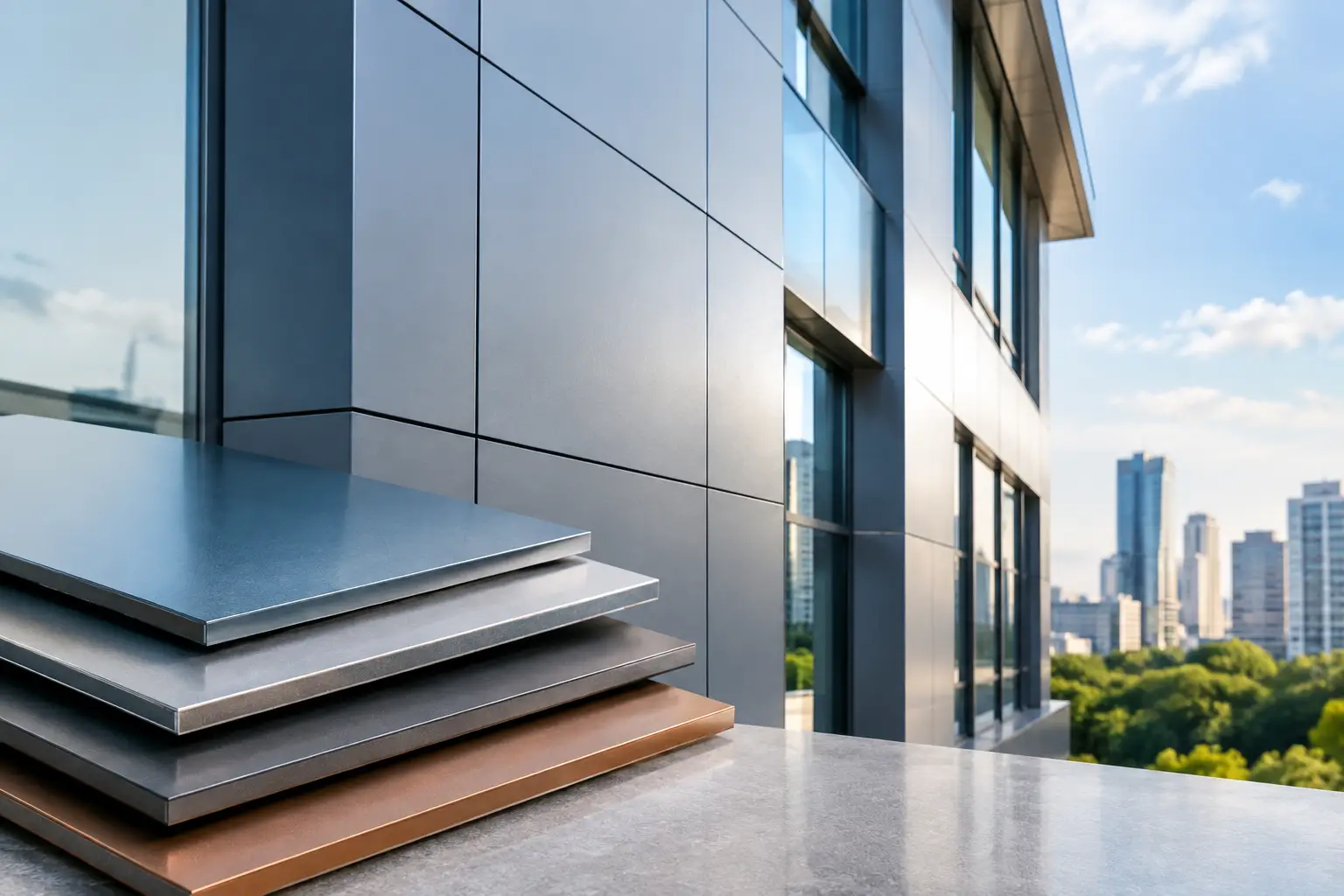
A facade can look resolved on a rendering long before its material strategy is resolved on the wall. ACM panels bring designers the flatness, color range, forming capability, and efficient coverage needed for expressive building envelopes. But for a high-rise, hotel, airport, mixed-use development, or corporate facility, panel selection must go beyond appearance. The specified ACM panel, its core classification, installation system, air and water barrier, insulation, attachments, and tested assembly must work together.
What ACM Panels Bring to the Building Envelope
Aluminum composite material panels are engineered sheets made from two aluminum skins bonded to a core. Their construction creates a lightweight yet rigid cladding material that can be routed, folded, curved, cassette-formed, or installed within a broad range of rainscreen and facade systems. This combination has made ACM a defining material across contemporary commercial architecture.
The value is not limited to aesthetics. Compared with many heavier facade materials, ACM can reduce handling demands and support efficient fabrication. Large-format panels can create clean visual planes with fewer visible joints, while custom colors, metallic effects, woodgrain appearances, stone-inspired finishes, and specialty metal skins allow the facade to support a building’s identity rather than merely cover its structure.
That flexibility does not eliminate the need for disciplined specification. Panel thickness, skin thickness, coating system, core type, fabrication method, joint design, support spacing, and exposure conditions all influence long-term performance. A panel chosen for a low-rise canopy is not automatically appropriate for a tall building in a demanding fire jurisdiction or a coastal environment.
Fire Performance Is an Assembly Question
For code-conscious projects, fire performance is the first material conversation, not a late-stage substitution review. ACM panels are available with different core formulations and fire classifications, including FR-A1, FR-A2, FR-B1, and FR-B2 options. The appropriate selection depends on the project location, occupancy, height, code pathway, authority having jurisdiction, and the complete exterior wall design.
A critical distinction is often missed during procurement: a panel classification is not the same as tested wall-assembly compliance. Fire behavior in a facade can be affected by the cladding, cavity, insulation, sheathing, air and water-resistive barrier, firestopping, attachment system, and detailing around openings. Where applicable, project teams should evaluate evidence for the actual proposed assembly under recognized standards such as NFPA 285, EN 13501, BS 8414, and CAN/ULC-S134.
The right question is not simply, “Is this a fire-rated panel?” It is, “Does this material belong within the code-compliant wall assembly proposed for this building?” That question should be answered with current technical documentation, engineering review, and coordination among the architect, facade consultant, contractor, fabricator, and code authority.
Matching the Core to Project Risk
Higher-performing mineral-core ACM products may be required or preferred where fire exposure, building height, occupancy, and local regulations demand a more rigorous approach. These materials can support ambitious facade concepts while addressing the realities of exterior-wall fire requirements.
At the same time, specifying a higher classification without confirming the surrounding assembly can create a false sense of security. The project must evaluate the complete system, including approved substitutions. A change in insulation, membrane, panel system, or attachment configuration may affect the basis for compliance, even when the visible panel finish remains unchanged.
Design Freedom Depends on Material Discipline
The visual potential of ACM starts with color, but successful facades are built through control of variation, reflection, geometry, and detailing. Solid colors offer crisp architectural definition. Metallic and mica finishes can add movement under changing daylight. Wood, stone, zinc, copper, bronze, stainless steel, titanium, and other specialty appearances can create a distinct material character while maintaining the advantages of composite panel fabrication.
Finish selection should account for elevation and orientation. A highly reflective color may read differently from one facade face to another. Dark colors can experience higher surface temperatures in strong sun. Large uninterrupted panels may require additional attention to oil canning, thermal movement, joint consistency, and support design. For high-visibility elevations, mockups remain one of the most effective tools for aligning expectations before full production begins.
Coating quality also matters. Exterior-grade paint systems should be selected for the climate, ultraviolet exposure, pollution level, and cleaning regime expected over the building’s service life. Color continuity requires attention across production batches, particularly where a project will be phased or where replacement panels may be needed years after occupancy.
Fabrication Shapes the Final Result
ACM is frequently specified because fabricators can turn flat material into precise architectural components. Routed-and-returned cassette panels, rainscreen planks, curved elements, column covers, parapet caps, soffits, and signage features can all be developed from a coordinated panel strategy.
However, fabrication details are not interchangeable. Minimum bend radii, routing depth, return dimensions, stiffener placement, sealant compatibility, drainage paths, and fastening approaches should follow the panel manufacturer’s requirements and the selected system design. A strong facade concept on paper can lose its precision if panel modules, corner conditions, and tolerances are left unresolved until installation.
Early coordination is especially valuable where ACM interfaces with curtain wall, glazing, louvers, precast concrete, stone, roofing, or other cladding materials. The cleanest-looking transitions are usually the result of clear responsibility for movement joints, flashing, cavity ventilation, and water management.
How to Specify ACM Panels With Fewer Surprises
A specification should establish more than a finish name and nominal thickness. It should define the panel product, core classification, aluminum skin thickness, exterior coating, approved color, fabrication expectations, performance criteria, and permitted system configurations. It should also identify the documentation required before fabrication and installation.
For major projects, the submittal process should include these distinct elements:
- Product data confirming panel construction, core type, coating system, and available dimensions.
- Fire-performance documentation relevant to the specified exterior-wall assembly and jurisdiction.
- Color and finish samples, along with full-size visual mockups where appearance is critical.
- Shop drawings showing panel modules, attachment methods, drainage, joints, transitions, and interfaces.
- Fabrication and installation requirements that preserve warranty conditions and system performance.
This level of definition protects both design intent and procurement certainty. It also gives contractors and fabricators a clear basis for pricing the actual scope rather than pricing a visually similar, technically different alternative.
Supply capability deserves the same scrutiny. Complex facades may require multiple widths, custom colors, specialty skins, rated cores, and phased deliveries across a long construction schedule. Manufacturers with vertically integrated control over mineral cores, bonding adhesives, color-coated coils, and custom paints are better positioned to manage consistency and production planning at scale. Alubond supports these requirements through global manufacturing and processing capacity across the UAE, Oman, Serbia, India, and Turkey, serving projects in more than 90 countries.
Performance Continues After Installation
ACM facades are designed for durability, but durability is not passive. The building team should provide access and a practical maintenance plan for inspection and cleaning. Routine cleaning can prevent the accumulation of airborne contaminants, while periodic reviews can identify damaged sealants, blocked drainage paths, loose fasteners, impact damage, or staining at runoff points.
The maintenance approach should respect the coating system. Abrasive pads, aggressive solvents, and unapproved cleaners can damage the finish or alter its appearance. Where replacement is necessary, matching should account for original batch information, weathering, gloss level, and the difference between a new panel and an aged elevation.
For owners, this is where a carefully specified facade proves its value. A material package that includes traceable product information, approved drawings, finish records, and maintenance guidance gives facilities teams a stronger foundation for protecting the building’s appearance and performance.
The most successful ACM facade is not selected from a color chip alone. It is engineered as a complete envelope decision: fire-conscious, fabricated with precision, supported by tested evidence, and supplied with the capacity to carry an architectural vision from first mockup to final elevation.
RECENT POSTS

September 16 , 2026

September 14 , 2026

September 12 , 2026

September 10 , 2026

September 8 , 2026

September 6 , 2026

September 4 , 2026

September 2 , 2026

August 31 , 2026

August 29 , 2026

August 27 , 2026

August 25 , 2026

August 23 , 2026

August 21 , 2026

August 19 , 2026

August 17 , 2026

August 15 , 2026

August 13 , 2026

August 12 , 2026

August 12 , 2026

August 12 , 2026

August 12 , 2026

August 12 , 2026

August 12 , 2026

August 12 , 2026

August 12 , 2026

November 2 , 2022

April 26 , 2022

