News
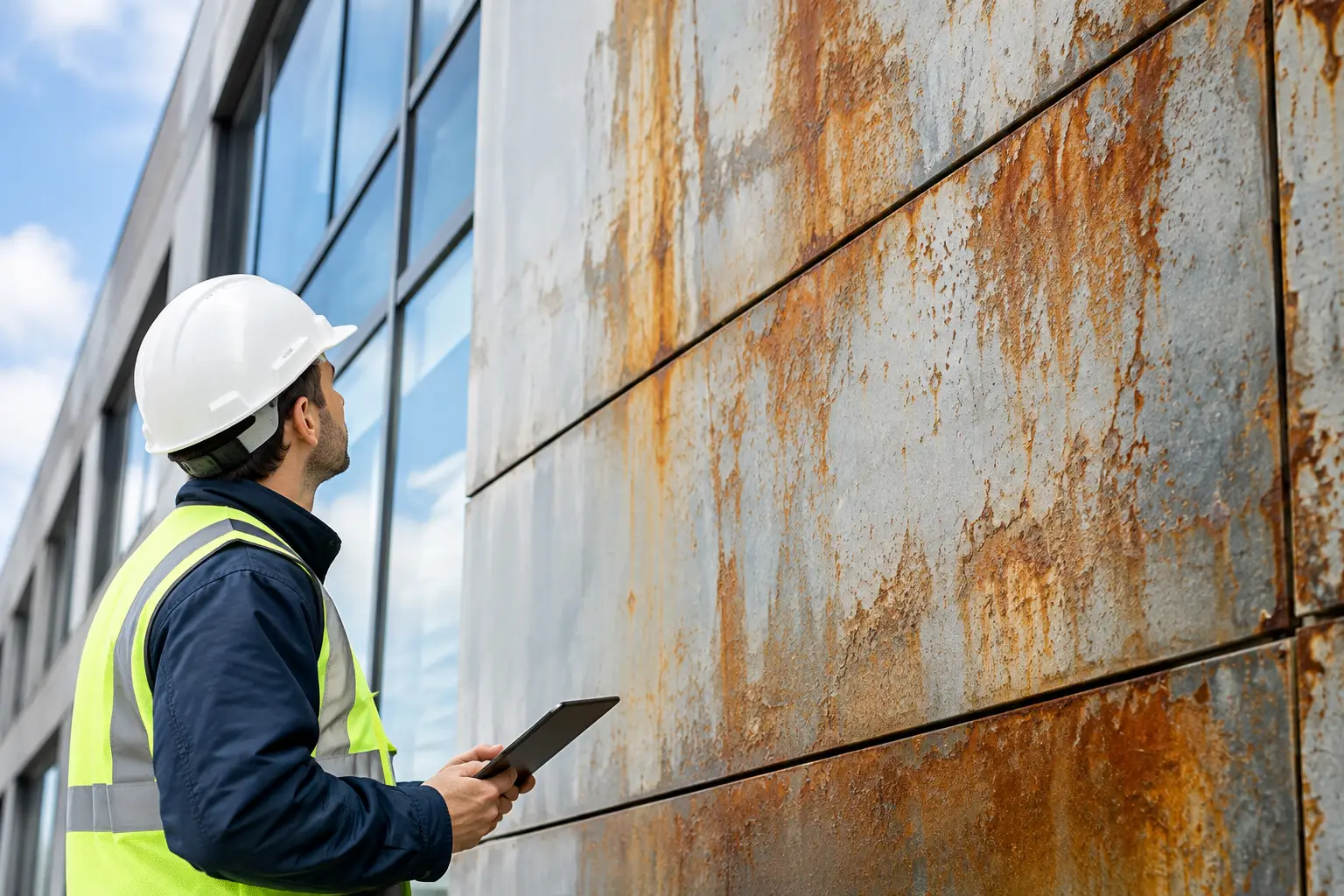
A facade rarely fails because of one dramatic event. More often, facade corrosion begins at an exposed cut edge, an unsealed fastener penetration, a poorly drained horizontal return, or an incompatible metal-to-metal connection. By the time staining, paint blistering, white oxidation, or rust runoff appears on the elevation, moisture may already be moving through joints and behind panels.
For architects, facade consultants, contractors, and owners, corrosion control is not a finish-only decision. It is an envelope design discipline. Material chemistry, coating specification, panel fabrication, attachment design, drainage, ventilation, and field maintenance must work together if a facade is expected to retain its appearance and performance through decades of weather exposure.
What Facade Corrosion Actually Means
Facade corrosion is the gradual deterioration of a metal component caused by its environment. The visible result may be cosmetic, but the underlying consequences can extend further: degraded coatings, reduced panel-edge protection, weakened fasteners, staining of adjacent materials, and compromised interfaces around openings and transitions.
Not all metals corrode in the same way. Aluminum develops a thin, naturally protective oxide layer. Under suitable conditions, that layer limits further attack. Steel, however, can develop iron oxide that expands and continues to expose new metal. Copper and bronze form patinas that may be intentional and protective, while stainless steel depends on its chromium-rich passive surface remaining clean and intact.
The relevant question is not whether a facade material can corrode. Every exterior metal system requires conditions, details, and maintenance appropriate to its environment. The question is whether the specified system has been engineered for the actual exposure it will face.
The Main Causes of Facade Corrosion
Moisture is the common denominator, but water alone does not explain most failures. Persistent wetting, trapped contaminants, salts, incompatible materials, and damaged finishes are usually what turn routine weather exposure into a corrosion problem.
Water Trapped Where It Cannot Drain
A rainscreen facade is designed to manage water, not pretend water will never enter a joint. Rain, condensation, and wind-driven moisture can reach cavities and interfaces. If horizontal surfaces lack slope, flashings terminate incorrectly, drainage paths are blocked, or weep openings are omitted, water remains in contact with metal for extended periods.
Crevices are especially vulnerable. Capillary action can hold moisture at panel overlaps, folded returns, fastener heads, and gasket interfaces. These locations dry slowly and often collect airborne contaminants. A visually clean elevation can therefore conceal localized corrosion at edges and concealed attachments.
Chlorides, Pollution, and Aggressive Exposure
Coastal locations require a different level of scrutiny than inland sites. Chloride-laden air can settle on metal surfaces and accelerate corrosion when moisture is present. Marine exposure is not limited to buildings directly on the shoreline. Wind patterns, elevation, and local geography can carry salts well inland.
Industrial districts, transportation corridors, and dense urban environments may introduce sulfur compounds, particulates, and pollutants that attack finishes or retain moisture. High humidity and frequent wet-dry cycles add further stress. A finish that performs well in a dry interior climate may be unsuitable for a coastal hotel, airport, waterfront tower, or fuel-service facility.
Galvanic Corrosion at Dissimilar Metals
Galvanic corrosion occurs when dissimilar metals are electrically connected in the presence of an electrolyte, usually water containing salts or contaminants. One metal becomes more active and corrodes at an accelerated rate, while the other is protected.
This risk is often created at details rather than across the panel face. Aluminum panels may meet steel framing, copper flashings, stainless steel fasteners, galvanized brackets, or other accessory metals. The design team must evaluate the complete assembly, including fasteners, rivets, shims, clips, sealant accessories, and runoff paths.
Isolation materials, compatible fasteners, protective coatings, and properly designed drainage can reduce galvanic risk. The correct approach depends on the metals involved and the degree of environmental exposure. A detail acceptable in a dry, protected soffit may not be acceptable on a salt-exposed parapet.
Coating Damage and Exposed Edges
High-performance coatings are a primary defense for architectural aluminum and coated steel skins, but they are not a substitute for disciplined fabrication and installation. Scratches, abrasion, overdriven fasteners, damaged panel edges, and improper cleaning can break the protective coating system.
Cut edges demand particular attention. Factory-applied coatings protect broad faces effectively, while fabricated edges and penetrations may require separate protection depending on the panel construction, metal skin, exposure classification, and project specification. Fabricators should follow approved procedures for routing, folding, cutting, handling, and edge treatment rather than relying on field touch-up as a universal remedy.
Designing Against Facade Corrosion
The most reliable corrosion strategy begins before product selection. It starts with a documented understanding of climate, building geometry, material interfaces, and service-life expectations.
Select Materials for the Exposure, Not Just the Appearance
A metallic finish, a solid aluminum panel, and a metal composite panel can each support distinctive architectural intent, but their suitability depends on the project environment and system design. Aluminum offers low weight, formability, and strong corrosion resistance in many exterior applications. Stainless steel, copper, bronze, titanium, galvanized steel, and other architectural metals bring different visual characteristics and durability profiles.
There are trade-offs. Stainless steel may provide excellent corrosion resistance, but its surface can still stain or show tea staining in chloride environments if finish selection and cleaning are neglected. Copper and bronze change naturally over time, which must be accepted as part of the design language. Coated aluminum offers broad color and finish flexibility, but coating quality, edge detailing, and installation protection remain critical.
For fire-rated composite cladding, corrosion performance must be considered alongside tested wall-assembly requirements and the applicable code pathway. A fire classification does not automatically establish environmental suitability, and a corrosion-resistant skin does not replace required fire-performance documentation. Both requirements must be resolved at the system level.
Detail the Rainscreen as a Drainage System
A durable facade allows incidental water to drain and the cavity to dry. This means continuous drainage planes, correctly placed flashings, open or pressure-moderated joint strategies where applicable, unobstructed weeps, and a clear path for water to exit at each horizontal interruption.
Panel joints should not direct runoff onto vulnerable dissimilar metals or exposed porous surfaces. At parapets, sills, copings, and projecting features, use slopes and drip details that carry water away from panel edges. Avoid creating dead-flat ledges that retain moisture and debris.
Ventilation also matters. An enclosed cavity that remains wet for long periods can increase corrosion risk at attachments and concealed components. The exact ventilation strategy depends on the facade system, climate, insulation arrangement, air barrier design, and code requirements, but drying potential should be reviewed with the same rigor as visible finish selection.
Specify Compatible Components
A panel system is only as durable as its least compatible interface. Specifications should identify approved attachment materials, fasteners, isolators, flashings, sealants, gaskets, and cleaning agents. Generic substitutions can introduce unanticipated galvanic pairs, chemical incompatibility, or localized coating damage.
For complex projects, submittal review should include enlarged details at corners, panel terminations, window perimeters, parapets, material transitions, and penetrations. These are the areas where water management and metal compatibility are most often tested. Full-scale mockups can reveal runoff patterns, joint alignment issues, and installation practices before they are repeated across thousands of square feet.
Fabrication and Installation Control Matter
Even a well-specified facade can be compromised by poor handling. Panels should be stored dry, protected from standing water, and kept clear of abrasive contact. Protective film must be removed according to manufacturer guidance. Leaving film on too long can create removal difficulties, adhesive residue, or uneven weathering.
During installation, crews should avoid dragging panels, using unapproved cutting tools, contaminating surfaces with carbon-steel particles, or forcing fasteners through misaligned holes. Sealants must be compatible with the panel finish and installed over properly prepared substrates. If field modifications are necessary, they should be reviewed against approved system details rather than treated as routine site adjustments.
Alubond supports specification-driven facade projects through a broad range of metal composite materials, fire-rated panels, solid aluminum options, finishes, and technical documentation. For any project, the final selection should align panel construction and finish requirements with the complete tested wall assembly, local code obligations, and environmental exposure.
Maintenance Is Part of Long-Term Protection
A facade does not become maintenance-free because it uses durable metals and premium coatings. Routine inspection and cleaning remove deposits that hold moisture or attack finishes, particularly in coastal and urban environments. The required frequency depends on rainfall, pollution levels, orientation, roof runoff, nearby construction activity, and salt exposure.
Inspections should focus on more than the panel face. Review sealant joints, drainage openings, flashing terminations, fasteners, panel edges, and areas below rooftop equipment or condensate discharge points. Early signs such as discoloration, blistering, white residue, rust streaking, loose fasteners, or persistent wet areas should trigger investigation before localized damage spreads.
Cleaning methods must suit the finish. Aggressive abrasives, strong alkaline cleaners, unapproved solvents, and contaminated tools can damage coatings or alter metal surfaces. Use manufacturer-approved procedures and test any unfamiliar cleaning method on a concealed area first.
A facade earns its service life through details that keep water moving, materials that belong together, and inspection practices that catch small defects while they are still small. Specify corrosion resistance as an assembled-system requirement, then protect that decision from the shop floor through the building’s operating life.
RECENT POSTS

November 19 , 2026

November 17 , 2026

November 15 , 2026

November 13 , 2026

November 11 , 2026

November 9 , 2026

November 7 , 2026

November 5 , 2026

November 3 , 2026

November 1 , 2026

October 30 , 2026

October 28 , 2026

October 26 , 2026

October 24 , 2026

October 22 , 2026

October 20 , 2026

October 18 , 2026

October 16 , 2026

October 14 , 2026

October 12 , 2026

October 10 , 2026

October 8 , 2026

October 6 , 2026

October 4 , 2026

October 2 , 2026

September 30 , 2026

September 28 , 2026

September 26 , 2026

September 24 , 2026

September 22 , 2026

September 20 , 2026

September 18 , 2026

September 16 , 2026

September 14 , 2026

September 12 , 2026

September 10 , 2026

September 8 , 2026

September 6 , 2026

September 4 , 2026

September 2 , 2026

August 31 , 2026

August 29 , 2026

August 27 , 2026

August 25 , 2026

August 23 , 2026

August 21 , 2026

August 19 , 2026

August 17 , 2026

August 15 , 2026

August 13 , 2026

August 12 , 2026

August 12 , 2026

August 12 , 2026

August 12 , 2026

August 12 , 2026

August 12 , 2026

August 12 , 2026

August 12 , 2026

November 2 , 2022

April 26 , 2022

