News
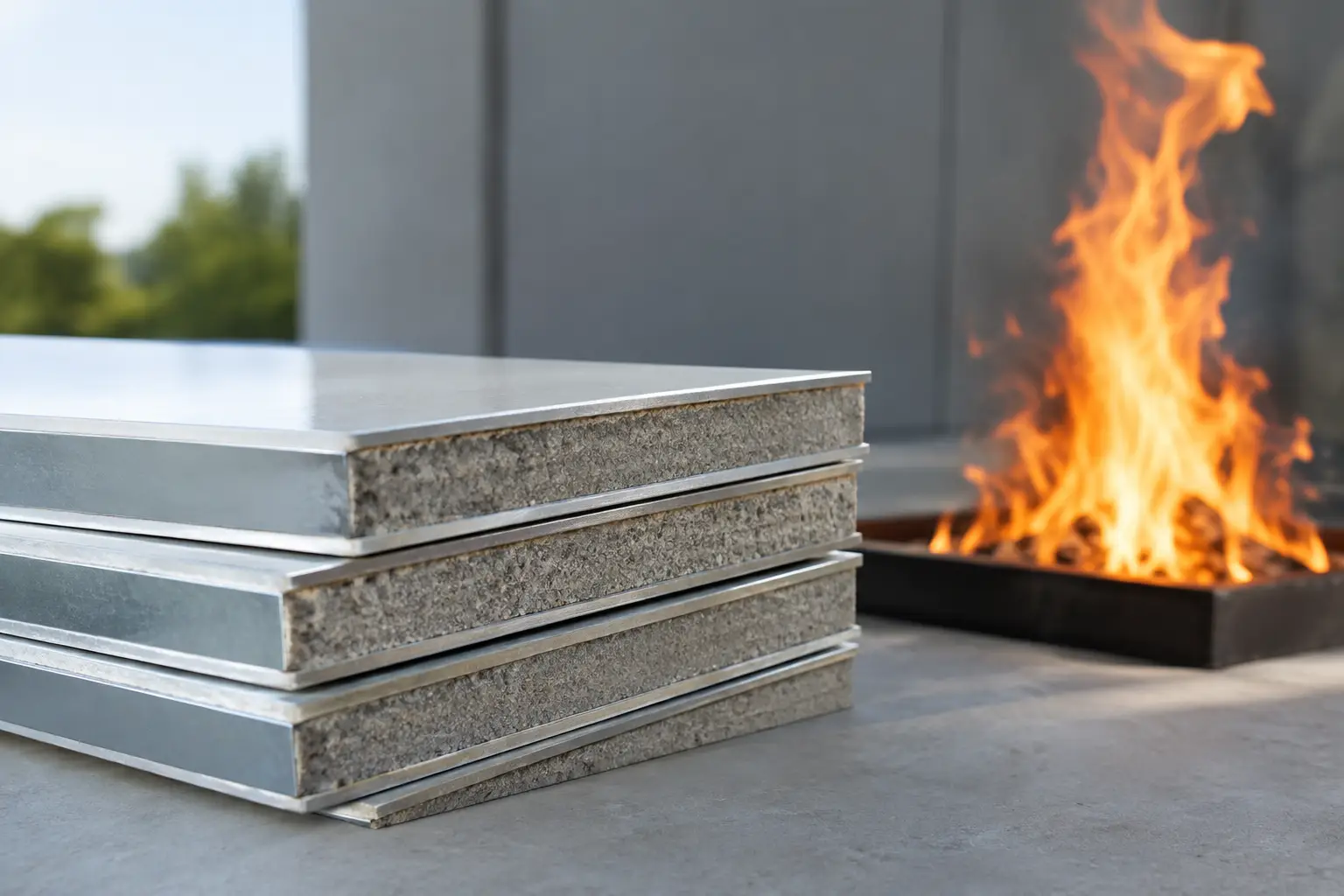
A facade specification can look compliant on paper and still fail to answer the question that matters most during design review: are MCM panels fireproof? The direct answer is no – fireproof is not a precise or sufficient performance category for metal composite material. The correct question is whether a specific panel, within a specific wall assembly, meets the fire-performance requirements of the project’s governing code.
For architects, facade consultants, contractors, and owners, that distinction is fundamental. MCM cladding performance is shaped by core composition, panel construction, insulation, air cavity conditions, attachment system, substrate, perimeter fire containment, and the evidence behind the complete exterior wall assembly. A metal skin alone cannot establish facade fire safety.
Are MCM Panels Fireproof?
MCM panels are not universally fireproof. They are engineered products with different core formulations and fire classifications. Some panels are intended for applications with limited fire-performance demands; others use mineral-filled or noncombustible cores developed for high-performance facade applications. The designation on the panel matters, but it is only the starting point.
An MCM panel typically consists of two metal skins bonded to a core. Aluminum skins do not contribute fuel in the way combustible plastics do, although aluminum can lose strength and melt at elevated temperatures. The central core is therefore decisive. A polyethylene-rich core can contribute significant fuel to a fire. A fire-retardant mineral core reduces combustible content and can improve reaction-to-fire performance. A panel with a noncombustible mineral core is designed for the most demanding fire classifications, subject to the applicable standard and documented test results.
Calling any of these products fireproof can create a dangerous false equivalence. Fire-resistance, reaction to fire, flame spread, smoke development, and full-scale facade performance are related but different measures. A panel may achieve a strong classification in one test and still require a tested wall assembly to satisfy the code for a multistory exterior wall.
The Core Determines the Starting Point
The practical difference between MCM product categories begins inside the panel. A standard combustible core, a fire-retardant mineral-filled core, and a noncombustible mineral core do not behave the same way when exposed to heat and flame. Material selection must follow the project’s occupancy, height, wall construction, jurisdiction, insurer requirements, and approved facade design.
Alubond manufactures fire-rated panel options including FR-A1, FR-A2, FR-B1, and FR-B2 categories, allowing project teams to align material selection with applicable regional requirements and performance targets. These labels should never be treated as interchangeable across markets. The standards, testing methods, acceptance criteria, and code pathways behind each classification must be reviewed in the project jurisdiction.
In European classification systems, EN 13501 provides a structured method for evaluating reaction-to-fire performance, including smoke and flaming-droplet classifications where applicable. An A1 classification represents the highest noncombustible category under that framework. An A2 classification is also highly restrictive in its combustible contribution, but it is not the same classification as A1. A B classification is a different performance level again.
For US projects, the terminology may be familiar, but compliance must be evaluated against the adopted building code and its referenced standards. A product classification from another region can support a technical discussion; it does not automatically establish US code compliance.
Why a Rated Panel Is Not the Entire Fire Solution
Exterior walls operate as assemblies, not as independent sheets of cladding. The panel is one component in a layered system that may include insulation, weather-resistive barriers, membranes, subframing, clips, fasteners, sealants, cavity barriers, backup walls, windows, and transitions. Each component can affect fire behavior.
This is especially significant where combustible components are present within an exterior wall assembly on buildings of Type I, II, III, or IV construction. In many US code applications, NFPA 285 is the benchmark referenced for evaluating whether an exterior wall assembly can resist vertical and lateral flame spread under a defined fire exposure. It is not a test of an MCM panel by itself.
A valid NFPA 285 path depends on matching the tested or approved assembly configuration. Substituting insulation type, changing the air-gap depth, altering the attachment system, introducing a different membrane, or replacing the cladding can move the design outside the scope of the tested assembly. This is why a generic statement that a panel is NFPA 285 compliant is incomplete. The responsible statement identifies the panel and the compatible wall assembly components covered by the test report, engineering analysis, evaluation report, or approved code-compliance pathway.
Full-scale system tests used in other markets follow the same principle. BS 8414 and CAN/ULC-S134 evaluate facade systems under severe exposure conditions. Their value lies in demonstrating performance of the combined wall design, not simply assigning a property to the face panel.
Do Not Confuse Common Fire-Test Terms
Specification teams often encounter several test references in submittals. Each answers a different question. ASTM E84, for example, evaluates surface-burning characteristics in a tunnel test. It may be required for certain interior applications or components, but it is not a substitute for NFPA 285 exterior wall assembly testing.
Similarly, ASTM E136 addresses noncombustibility of materials under its test method. It does not prove that every component in a finished facade assembly is noncombustible, nor does it replace an exterior wall fire-propagation assessment. Fire-resistance ratings under tests such as ASTM E119 concern the ability of building assemblies to withstand fire exposure for a defined period. That is a separate issue from reaction-to-fire classification or facade flame-spread performance.
The discipline is straightforward: match the requested performance claim to the relevant test standard, the exact product, and the intended assembly. A concise, well-documented submittal is more valuable than a long collection of unrelated certificates.
How to Specify MCM Panels for Fire-Critical Projects
Start with the governing code and the authority having jurisdiction, then establish the required facade compliance pathway before selecting finishes or panel geometry. This prevents a late-stage conflict in which a preferred visual concept cannot be supported by the required fire-performance documentation.
Next, confirm the core category and product-specific technical data. The submittal should identify panel thickness, skin material and thickness, core type, finish, fabrication limits, and the exact manufacturing source where relevant. Fire performance belongs to the specific product configuration, not simply the brand family name.
Then evaluate the complete wall. Confirm the backup wall, insulation, membrane, cavity dimensions, attachment system, joint design, and perimeter fire-containment details against the tested assembly or engineering judgment. Changes that appear minor to the design team can be material to the compliance analysis.
Finally, coordinate early among the architect, facade consultant, general contractor, fabricator, manufacturer, fire consultant, and code official. Early coordination protects both design intent and construction sequencing. It also gives procurement teams time to verify that the specified rated product, compatible system components, and supporting documentation are available for the project schedule.
Design Freedom Still Requires Technical Discipline
Fire-conscious MCM specification does not require a limited architectural palette. High-performance facades can incorporate custom colors, metallic effects, stone and wood-inspired surfaces, anodized appearances, and alternative metal skins while maintaining a disciplined fire-performance strategy. The critical requirement is that aesthetic decisions remain inside the boundaries of the qualified product and assembly.
This is where vertically integrated manufacturing creates a practical advantage. Control over mineral core formulation, bonding technology, coated coil production, and finish development supports consistency from technical approval through project delivery. For large projects, that control also matters when panels must be produced at scale without changing the approved construction.
The best next step is not to ask for a blanket assurance that an MCM panel is fireproof. Ask for the exact panel data, the governing fire standard, and the documented wall assembly that supports the proposed facade. That conversation gives the project team a defensible route from concept to approval to installation.
RECENT POSTS

October 18 , 2026

October 16 , 2026

October 14 , 2026

October 12 , 2026

October 10 , 2026

October 8 , 2026

October 6 , 2026

October 4 , 2026

October 2 , 2026

September 30 , 2026

September 28 , 2026

September 26 , 2026

September 24 , 2026

September 22 , 2026

September 20 , 2026

September 18 , 2026

September 16 , 2026

September 14 , 2026

September 12 , 2026

September 10 , 2026

September 8 , 2026

September 6 , 2026

September 4 , 2026

September 2 , 2026

August 31 , 2026

August 29 , 2026

August 27 , 2026

August 25 , 2026

August 23 , 2026

August 21 , 2026

August 19 , 2026

August 17 , 2026

August 15 , 2026

August 13 , 2026

August 12 , 2026

August 12 , 2026

August 12 , 2026

August 12 , 2026

August 12 , 2026

August 12 , 2026

August 12 , 2026

August 12 , 2026

November 2 , 2022

April 26 , 2022

