News
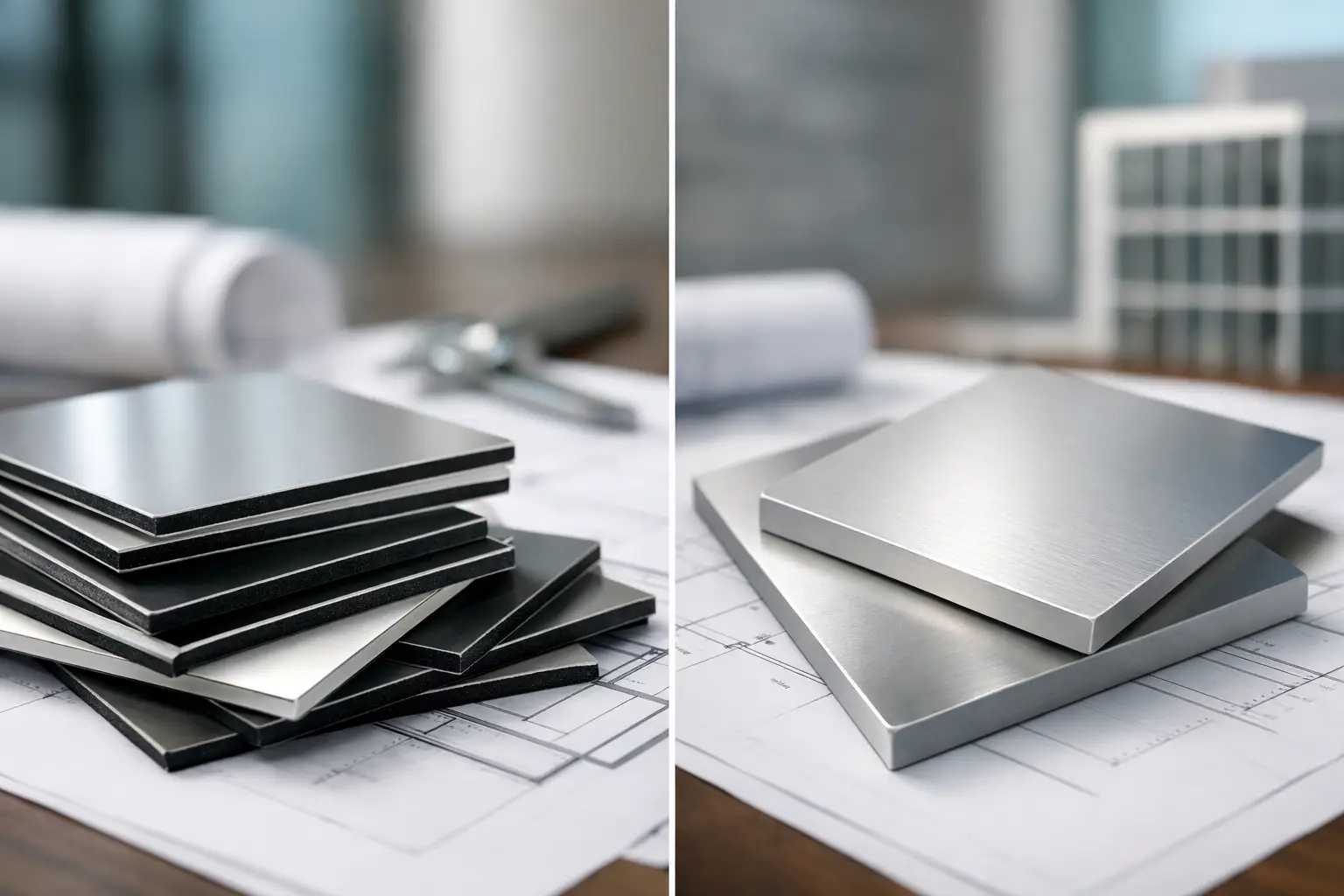
A facade specification can look settled until the team reaches panel material. ACP versus solid aluminum panels is not a simple question of appearance, because both can deliver flat, durable metal surfaces while placing very different demands on structure, fabrication, fire strategy, and budget. For high-rise, hospitality, transportation, retail, and corporate projects, the right choice must be made at the wall-assembly level, not from a finish sample alone.
ACP Versus Solid Aluminum Panels: The Material Difference
Aluminum composite panel, commonly called ACP or MCM, consists of two aluminum skins bonded to a core. The resulting panel has a high stiffness-to-weight ratio, allowing broad, exceptionally flat facade surfaces with relatively low panel weight. The core may be polyethylene, fire-retardant mineral-filled material, or a noncombustible mineral composition, depending on the product classification and project requirements.
Solid aluminum panels are fabricated from a single sheet or plate of aluminum. They may be brake-formed, routed, perforated, welded, curved, or engineered into more sculptural geometries. Because there is no composite core, the panel is a homogeneous metal substrate, although its alloy, thickness, temper, coating, attachment method, and backing conditions still affect real-world performance.
The visible result can be similar: a crisp metallic plane, a custom color, a woodgrain, stone-like finish, or a highly reflective surface. The engineering path to achieve that result is not. ACP is fundamentally optimized for lightweight flatness and efficient cassette fabrication. Solid aluminum is often selected for formed details, impact-exposed zones, demanding geometry, or projects where a monolithic metal panel is required by the specification.
Weight, Flatness, and Structural Demand
Weight is often the first measurable distinction. A typical 4 mm composite panel is substantially lighter than a solid aluminum sheet capable of delivering comparable apparent rigidity. This can reduce dead load on the backup wall and subframing, improve handling on site, and support faster installation across large elevations.
For tall buildings and extensive commercial envelopes, those weight savings can influence bracket design, logistics, crane planning, and labor productivity. ACP also resists oil-canning effectively because its separated skins create panel stiffness without requiring a heavy gauge of solid metal. On long, uninterrupted facade runs, this is a major design and fabrication advantage.
Solid aluminum panels can achieve excellent flatness, but the required thickness depends on panel size, support spacing, wind pressures, forming details, and the acceptable visual tolerance. Thin sheet is more susceptible to visible waviness. Increasing thickness improves rigidity, but adds material cost and structural load. For small modules, deep returns, or reinforced formed components, solid aluminum may be entirely practical. For expansive rainscreen fields, composite construction frequently offers a more efficient balance.
Fire Performance Must Be Evaluated as a System
Neither panel category should be treated as automatically appropriate for every occupancy, height, or jurisdiction. Fire performance depends on the exact panel construction, insulation, air and water barrier, cavity configuration, attachment system, and wall assembly. A material description such as “aluminum” does not replace tested-system evidence.
For ACP, core formulation is central. FR-B2, FR-B1, FR-A2, and FR-A1 classifications describe different fire-performance categories under applicable standards, but they are not interchangeable. The project team must confirm the governing code, local amendments, panel classification, test reports, and system-specific scope before approval.
Solid aluminum itself is noncombustible, but that does not remove the need to evaluate the complete facade. Aluminum loses strength as temperatures rise and can melt under severe fire exposure. More critically, the cladding panel is only one component of a wall assembly that may include insulation, membranes, sealants, cavity barriers, and attachment elements. Where NFPA 285 is required, a tested or properly engineered assembly is the relevant benchmark, not an isolated material claim.
Alubond supports specification-driven facade decisions with fire-rated panel options and documentation tied to recognized standards and test frameworks, including NFPA 285, EN 13501, BS 8414, and CAN/ULC-S134 where applicable. The design team should verify the exact proposed configuration, rather than assuming a certification transfers from one panel thickness, insulation type, or mounting system to another.
Fabrication and Design Freedom
ACP is highly adaptable for routed-and-returned cassette systems. Fabricators can create clean corners, reveals, tray panels, and integrated stiffening details efficiently because the aluminum skins can be routed while preserving a controlled bend line. This makes ACP particularly effective for unitized visual grids, column covers, soffits, parapets, fascia, and large-format rainscreen panels.
Solid aluminum offers a different kind of freedom. It is well suited to deep brake forming, welded assemblies, perforated screens, press-formed shapes, and durable custom components that must withstand concentrated use or abuse. It is also a natural choice for complex metalwork that cannot be produced through standard composite-panel routing methods.
The decision often turns on detail complexity. If the visual concept depends on broad planar surfaces, sharp folded returns, and lightweight modular cladding, ACP is usually compelling. If it depends on sculptural depth, exposed edge conditions, perforation, welded geometry, or heavy-duty components, solid aluminum may offer the better fabrication platform. Some projects use both, assigning each material to the elevations and details where it performs best.
Finishes, Weathering, and Visual Consistency
Both materials can be finished in an extensive range of colors, metallics, woodgrains, stone effects, and custom coatings. The key issue is not whether a finish is available, but whether it can be supplied consistently across the project, fabricated without damage, and supported by the required warranty conditions.
Coil-coated ACP can provide highly consistent color and gloss across large production runs. It is especially strong for projects that require a uniform architectural identity across multiple buildings, phases, or markets. Solid aluminum can also be coated to a high standard, though fabrication sequences may introduce different touch-up, weld, edge, and forming considerations.
Coating selection should match exposure. Coastal environments, desert heat, industrial atmospheres, heavy ultraviolet exposure, and high-touch public areas each place different demands on the finish. Specify the coating system, color tolerance, gloss range, batch-control process, cleaning guidance, and warranty terms early. A dramatic finish that cannot be consistently reproduced or maintained is not a durable facade solution.
Cost Should Be Measured Beyond Panel Price
ACP commonly provides an economical installed solution for large-area cladding because it uses less aluminum by weight and can be fabricated into stiff cassette panels efficiently. Savings may extend beyond the panel itself through lower handling loads, reduced subframe demand, and installation productivity.
Solid aluminum can carry a higher material cost, particularly at thicker gauges. That premium may be justified when the project requires specialized forming, exceptional impact resistance, a monolithic substrate, or a detail that eliminates secondary fabrication steps. Comparing only cost per square foot can produce the wrong conclusion.
A meaningful comparison includes panel yield, waste, shop labor, reinforcement, subframing, brackets, fasteners, shipping, field installation, maintenance access, replacement strategy, and the cost of satisfying fire and code requirements. It should also account for supply reliability. On a phased international project, confirmed manufacturing capacity and finish continuity can be as valuable as a favorable initial quotation.
How to Specify the Right Panel
Start with the facade zone and the governing performance criteria. Establish wind loads, module dimensions, impact exposure, fire requirements, thermal movement, drainage strategy, required testing, and aesthetic intent. Then determine whether the wall assembly requires a specific tested configuration and whether the selected panel can be integrated within that scope.
For ACP, specify the core category, skin thickness, overall panel thickness, finish, fabrication method, and approved attachment system. For solid aluminum, specify alloy, temper, gauge, coating, forming tolerances, reinforcement requirements, and treatment of exposed or cut edges. In either case, require coordinated shop drawings that address panel joints, pressure equalization, flashing, isolation of dissimilar metals, and allowance for thermal expansion.
The strongest specifications do not force one material across every condition. They select ACP where lightweight flatness, scale, and efficient cassette fabrication create value, then use solid aluminum where the detail demands a formed, perforated, impact-resistant, or monolithic solution. When facade performance is evaluated as a complete engineered assembly, the material choice becomes clearer – and the finished building is better prepared to perform for decades.
RECENT POSTS

October 12 , 2026

October 10 , 2026

October 8 , 2026

October 6 , 2026

October 4 , 2026

October 2 , 2026

September 30 , 2026

September 28 , 2026

September 26 , 2026

September 24 , 2026

September 22 , 2026

September 20 , 2026

September 18 , 2026

September 16 , 2026

September 14 , 2026

September 12 , 2026

September 10 , 2026

September 8 , 2026

September 6 , 2026

September 4 , 2026

September 2 , 2026

August 31 , 2026

August 29 , 2026

August 27 , 2026

August 25 , 2026

August 23 , 2026

August 21 , 2026

August 19 , 2026

August 17 , 2026

August 15 , 2026

August 13 , 2026

August 12 , 2026

August 12 , 2026

August 12 , 2026

August 12 , 2026

August 12 , 2026

August 12 , 2026

August 12 , 2026

August 12 , 2026

November 2 , 2022

April 26 , 2022

